On October 26th, 2023, a paper themed on the latest collaborative research findings titled Spatial Pattern of Marine Oxygenation Set by Tectonic and Ecological Drivers over the Phanerozoic, written by Research Fellow Wang Xiangli from the Institute of Geology and Geophysics at Chinese Academy of Sciences (CAS), and Professor Li Chao from the International Center for Sedimentary and Biogeochemistry (the Center) at CDUT, was published in Nature Geoscience. Research Fellow Wang Xiangli is the first author of this article, while Li Chao and Wang Xiangli are the corresponding authors. Experts and scholars from University of Cincinnati in the United States and Nanjing Institute of Geology and Palaeonotology at CAS, also contributed to this research.
Changes in dissolved oxygen levels in the ocean have a profound impact on the biogeochemical cycles of Earth’s elements and the evolutionary habitability. However, the trends and driving mechanisms of marine redox evolution since the Phanerozoic (approximately <538 million years ago) remain unclear. This study utilized big data analysis and machine learning methods to reconstruct nearly continuous spatiotemporal records of marine redox evolution in major oceanic sedimentary environments (Fig. 1) since the Phanerozoic, based on changes in trace metal element concentrations in shales.
The research reveals that, from the Cambrian to the Devonian before the colonization of land by plants, deep continental shelves generally remained in an anoxic state. After the Devonian, the range of oceanic anoxia gradually contracted, giving rise to the stable and persistent oceanic oxygen minimum zone, forming the modern marine redox model. The evolutionary changes on the scale of tens of millions to billions of years are positively correlated with the rate of oceanic crustal growth (indicating tectonic activity intensity) and sea-level changes dominated by tectonic activities. This suggests that the intensity of tectonic activity may be one of the primary controlling factors influencing marine redox states on long timescales. On the scale of several million years in the Phanerozoic, the study observes a reverse variation pattern between the upper seawater and the redox state of deep shelf and (semi-)restricted basin seawater. This pattern aligns closely in time with crucial life evolution events (such as the expansion of Paleozoic terrestrial vegetation and the Mesozoic plankton revolution) and tectonic events (such as the aggregation and breakup of the Pangea supercontinent), indicating the significant influence of tectonic and ecosystem evolution on the marine redox evolution in the Phanerozoic ancient oceans.
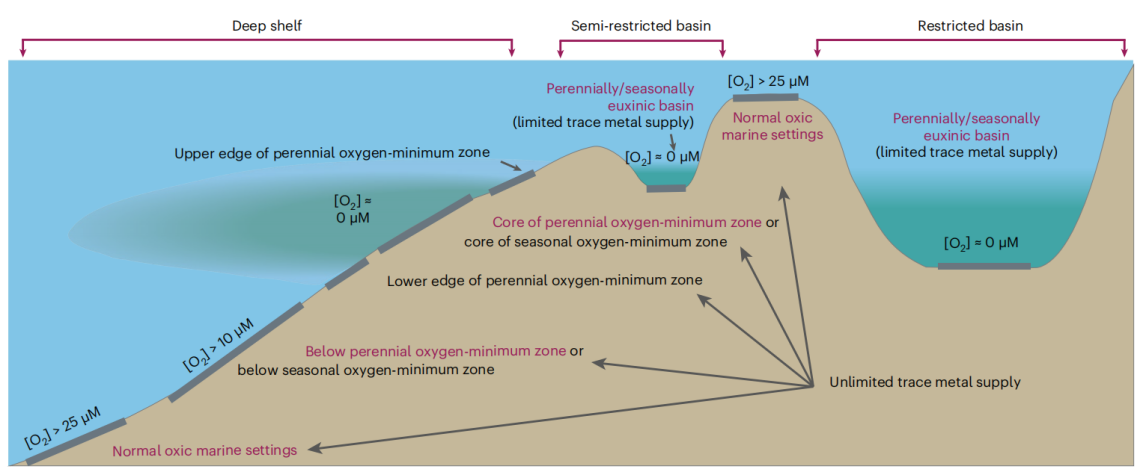
Diagram of Shale Sedimentary Environment
The Center was established in March 2022, as a specialized research institution affiliated with the Institute of Sedimentary Geology and the State Key Laboratory of Oil and Gas Reservoir Geology and Exploitation at CDUT. The Center primarily engages in fundamental and applied research in the fields of sedimentary biogeochemistry and biogeochemistry (including isotope geochemistry). The current research focuses on the reconstruction of Earth’s surface environmental systems during geological history and related technological developments. It explores the relationship between Earth system habitability and biological evolution, as well as the resource and energy effects in sedimentary and biogeochemical processes.
This research is funded by the National Natural Science Foundation of China (No. 41888101, No. 42293293, No. 41921002, No. 41821001, No. 41825019, and No. 42130208), the National Key Research and Development Program of China (No. 2022YFF0800100 and No. 2020YFA0607700), and the Plan 111 (No. BP0820004).
Paper Information (*corresponding authors):
Xiangli Wang*, Thomas J. Algeo, Chao Li*, Maoyan Zhu. 2023. Spatial pattern of marine oxygenation set by tectonic and ecological drivers over the Phanerozoic. Nature Geoscience. DOI: 10.1038/s41561-023-01296-y.
Xiangli Wang, Thomas J. Algeo, Chao Li, Maoyan Zhu. 2023. Spatial pattern of marine oxygenation set by tectonic and ecological drivers over the Phanerozoic. Nature Geoscience. DOI: 10.1038/s41561-023-01296-y.