The Landslide Dynamics Team of the State Key Laboratory of Geohazard Prevention and Geoenvironment Protection (SKLGPGP) at CDUT, supported by Major Project and the Research Plan on Everest Science of National Natural Science Foundation of China (NSFC), has made progress in the research field of physical mechanism of stick-slip effect and precursor characteristics of earthquake foreshocks. The research paper, titled Stick-Slip Nucleation and Failure in Uniform Glass Beads Detected by Acoustic Emissions in Ring-Shear Experiments: Implications for Identifying the Acoustic Emissions of Earthquake Foreshocks, was published on Journal of Geophysical Research: Solid Earth (JGR: Solid Earth) in September 2023. The team collaborated with institutions such as Shanghai Jiao Tong University, the Institute of Geological and Nuclear Sciences in New Zealand, and the Institute Laue-Langevin in Paris, France.
The stick-slip effect is one of the crucial factors controlling the occurrence of quasi-periodic earthquakes and step-like deformation in landslides. The mechanical evolution of fault gouges prior to earthquake occurrence is extremely complex and difficult to predict. However, many studies have observed the presence of significant microslip prior to stick-slip failure of seismic faults, which may provide precursor information for an impending earthquake. Microslip refers to small earthquakes or deformations that occur in time and space proximity to earthquakes or landslides. Numerous observational reports suggest that microslip activity increases before the occurrence of earthquakes or landslides, and the closer to the main slip time, the higher the rate of microslip occurrences. Associated acoustic emission (AE) events exhibit a strong correlation with microslip. However, due to limitations in field observations, the physical mechanisms controlling microslip events remain controversial. Laboratory studies on stick-slip mechanisms can effectively reveal the physical processes of microslip, providing crucial theoretical support for accurately identifying microslip signals before earthquakes or landslides and improving the success rate of landslide prediction and forecasting in the field.
The shear bands of faults and landslides typically exist in granular form. To address the scientific issue of the stick-slip physical mechanism in granular media, the research team utilized ultra-high-frequency AE monitoring. They conducted research on stick-slip nucleation and failure mechanisms in granular media and developed an ultra-high-frequency AE-ring shear synchronous experimental system. Their experimental results of high-frequency AE and ring-shear simultaneous acquisition showed that stick-slip failure (corresponding to the occurrence of an earthquake) leads to a decrease in the shear resistance of a granular system, generating high-frequency acoustic signals. Increments of microslip increased the shear resistance of the granular system, and were recorded as low-frequency acoustic signals before failure occurred. The team suggests that the stick-slip nucleation and failure were controlled by grain friction and collision, respectively. The different AE frequencies of the two may shed light on the precursor monitoring of quasi-periodic earthquakes.
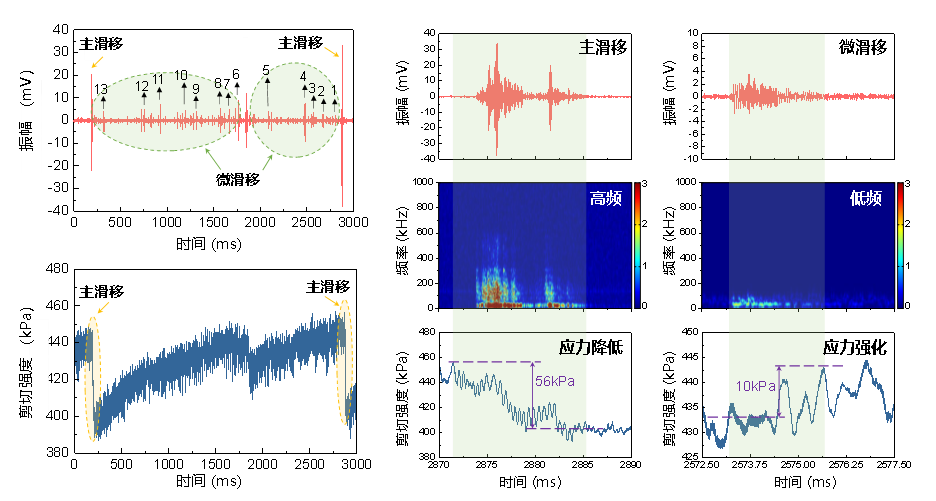
▲Mechanical and Acoustic Emission Frequency Characteristics of Main slip and Microslip in Stick-slip Failure of Granular Media
The JGR: Solid Earth is a flagship academic journal sponsored by the American Geophysical Union (AGU). It is included in the Nature Index and stands as one of the most influential top-tier academic journals in the international geophysics community.
The Landslide Dynamics Team belongs to the Youth Science and Technology Innovation Research Team of Sichuan Province . Professor Hu Wei, the team leader, is the corresponding author of this research achievement. Dr. Gou Huaixiao, a member of the team, is the first doctoral student of the SKLGPGP to publish academic results as the first author in this journal. He graduated from CDUT in 2015 with a degree in Civil Engineering. During his combined master’s and doctoral studies, he has already published a total of six SCI papers, including three papers indexed in the Nature Index and four papers on Q1 journals ranked by the Chinese Academy of Sciences. He has also been involved in national projects such as the Major Projects of NSFC and Major Research Plans of the Ministry of Science and Technology.
Gou, H. X., Hu, W., Xu, Q., Huang, R. Q., McSaveney, M. J., Jia, X., & Wang, Y. J. (2023). Stick-slip nucleation and failure in uniform glass beads detected by acoustic emissions in ring-shear experiments: Implications for identifying the acoustic emissions of earthquake foreshocks. Journal of Geophysical Research: Solid Earth, 128, e2023JB026612.
Gou, H. X., Hu, W., Xu, Q., Huang, R. Q., McSaveney, M. J., Jia, X., & Wang, Y. J. (2023). Stick-Slip Nucleation and Failure in Uniform Glass Beads Detected by Acoustic Emissions in Ring-Shear Experiments: Implications for Identifying the Acoustic Emissions of Earthquake Foreshocks. Journal of Geophysical Research: Solid Earth, 128, e2023JB026612.
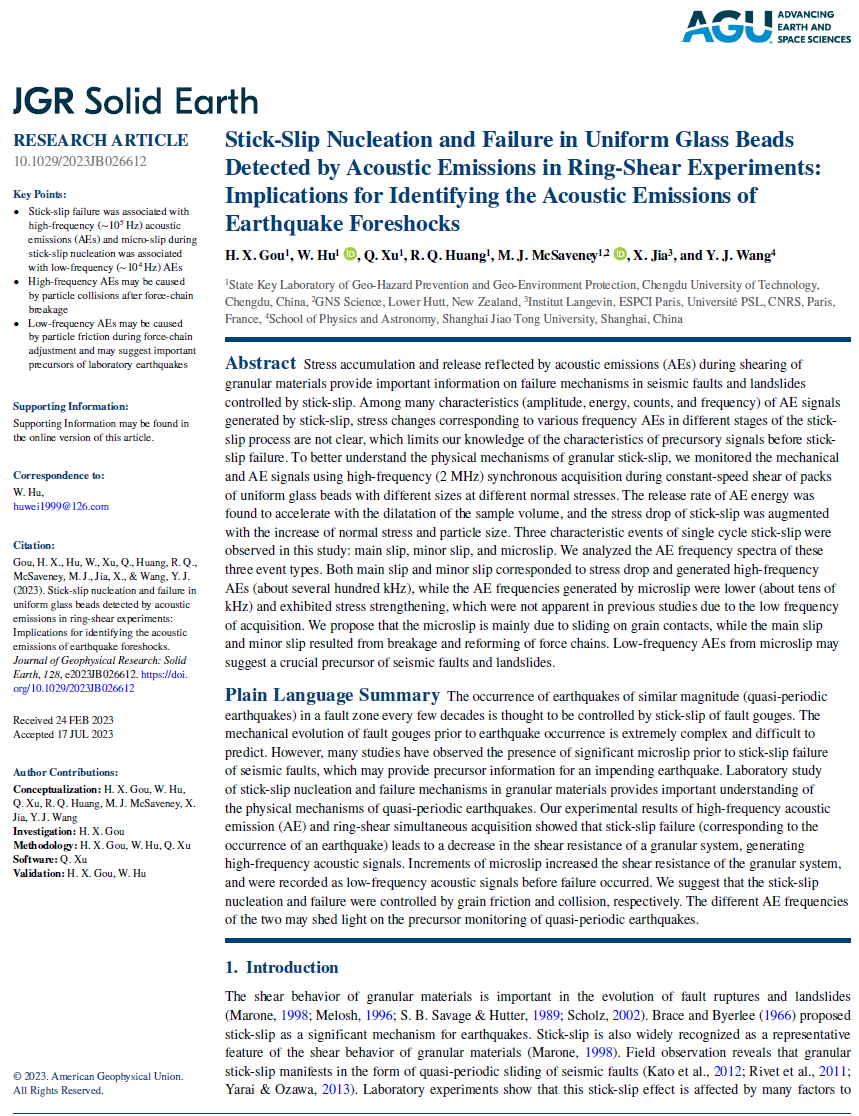
▲The Home Page of the Research Paper Published on Journal of Geophysical Research: Solid Earth