First Paper in the Year of the Rabbit | Science: Nucleosynthetic Anomalies of Potassium-40 in Primitive Meteorites
On January 27th, a paper titled "Meteorites have inherited nucleosynthetic anomalies of potassium-40 produced in supernovae" was published in Science and included in the Highlight of this corresponding issue, which is a collaborative research result between Nie Xike from the Carnegie Institution for Science, Washington, DC and Wang Da from the International Center for Planetary Science, College of Earth Sciences, Chengdu University of Technology (CDUT).
Planets in the solar system are generally thought to have formed by accretion in different regions of a primordial solar nebula composed of gas and dust. Unlike other planets in the solar system, our home planet, Earth, contains large amounts of water and volatiles necessary for human activities and other vital activities. How Earth-like planets obtained sufficient water and volatiles during their formation to possess the basic conditions for habitation is one of the important questions the field of planetary science focuses on. The collaborative research paper between Nie Xike and Wang Da that has reported for the first time potassium isotope anomalies in primitive meteorites may help answer the above question.
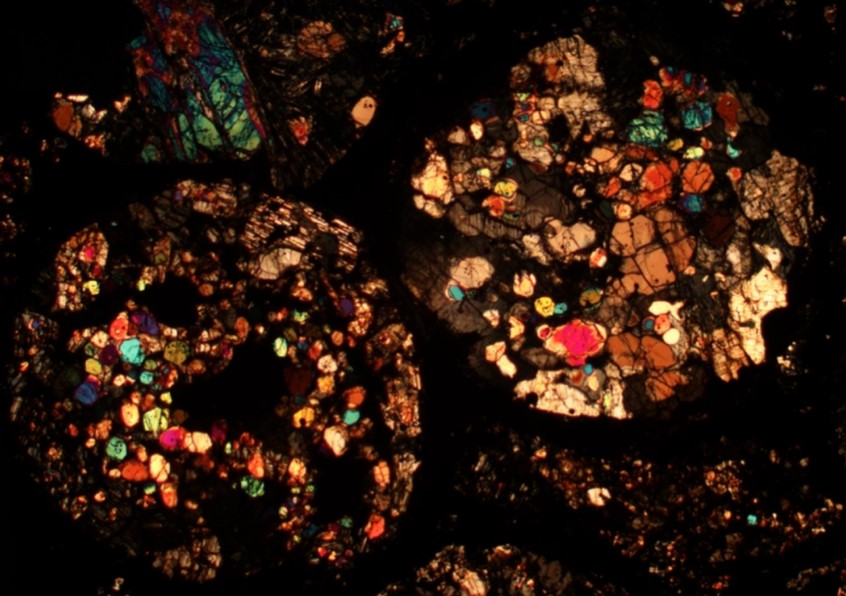
Microscope Photo of a Slice of a Primitive Chondrite Meteorite
Primitive meteorites contain leftover material from planet formation in the solar nebula, which can be used to indicate the origin of the original building material of planets. Nucleosynthetic anomalies are small differences in isotope ratios left by incomplete mixing of extrasolar material (presolar grains) in the primordial solar nebula. Nucleosynthetic anomalies of isotopes are already known for refractory elements (e.g., Cr, Ti and Mo), which condense into solid grains first, but it has been unclear whether more volatile elements were fully mixed (because of their lower semi-condensation temperatures) before planet formation.
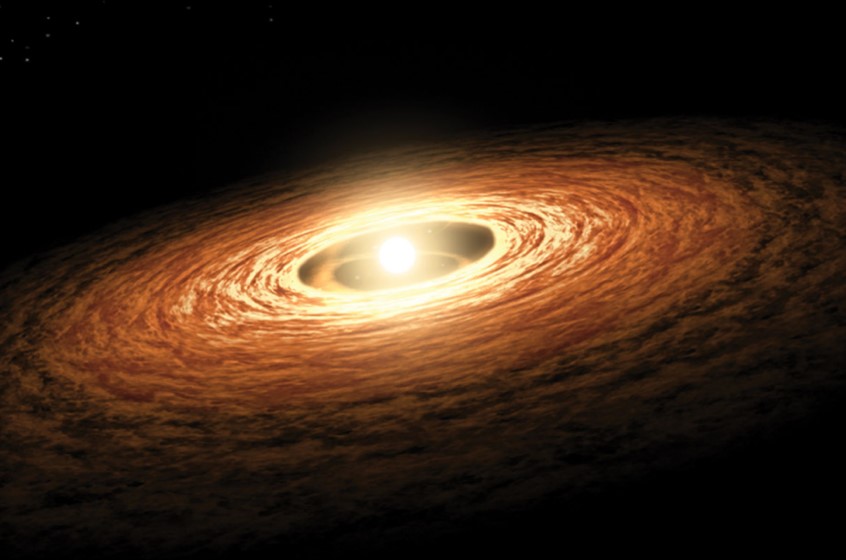
The primordial solar nebula may already have the material conditions for the formation of a habitable planet (phantom drawing, NASA-JPL)
The research conducted high-precision three-potassium (K-39, K-40, K-41) isotope tests on 32 different meteorites and identified nucleosynthetic anomalies in potassium-40 contained in carbonaceous chondrite meteorites formed in the outer regions of the solar system, which is consistent with supernova explosion products, while non-carbonaceous meteorites formed in the inner solar system have potassium-40 isotope ratios similar to those of Earth. This new finding suggests that Earth's moderately volatile elements are mainly from the relatively more inner regions of the solar nebula and a view different from the conventional ones that volatiles may have survived in some kind of carrier in the sun's non-cold regions. This implies that planets with large amounts of volatiles may be common in other stellar systems, i.e., there may be many blue habitable planets like Earth in the vast universe.
The research was published in the international journal Science, with Nie Xike from the Carnegie Institution for Science, Washington, DC and Wang Da from the International Center for Planetary Science, College of Earth Sciences, CDUT being the joint first and corresponding authors, with other co-authors including Zack Torrano, Rick Carlson, Conel Alexander and Anat Shahar from the Carnegie Institution for Science, Washington, DC.
Original paper information:
Nie, N.X.*,†, Wang, D. *,†, Torrano, Z.A., Carlson, R.W., Alexander, C.M.O’D., Shahar, A., 2023. Meteorites have inherited nucleosynthetic anomalies of potassium-40 produced in supernovae. Science, v. 379, 6630, 372-376
https://www.science.org/doi/10.1126/science.abn1783
Article by International Center for Planetary Science