Meeting in the Cloud | International Workshop on Earthquake and Climate Change-Induced Geological Hazards in High Mountain Areas Held Online
From May 11 to 12, the International Workshop on Earthquake and Climate Change-Induced Geological Hazards in High Mountain Areas was held online. The workshop was sponsored by the State Key Laboratory of Geohazard Prevention and Geoenvironment Protection and the Department of International Exchange & Cooperation of our university and co-organized by the Geological Hazard Research Branch of the Geological Society of China and the International Research Association on Large Landslides (iRALL). The workshop was aimed to present the cutting-edge research direction and progress of different types of disasters in structurally active alpine areas, and to explore international cooperation platforms and mechanisms.
The workshop was held online. A number of well-known experts in the industry including Prof. Niels Hovius from Helmholtz-Centre Potsdam-German Research Centre for Geosciences (GFZ), Dr. Chris Massey from Institute of Geological and Nuclear Sciences Limited (GNS Science), New Zealand, Prof. Marten Geertsema from University of Northern British Columbia (UNBC), and Prof. Paul Carling from University of Southampton (Soton) attended the workshop.
It is reported that at this meeting, world-renowned scientists will jointly study the mechanism, simulation, early warning and prediction of geological disasters induced by earthquakes and climate changes in structurally active mountainous areas, especially in the Hindu Kush-Himalaya and Qinghai-Tibet Plateau regions, including strong earthquakes geological disaster chains, glaciers and permafrost disaster chains caused by global climate change, etc.
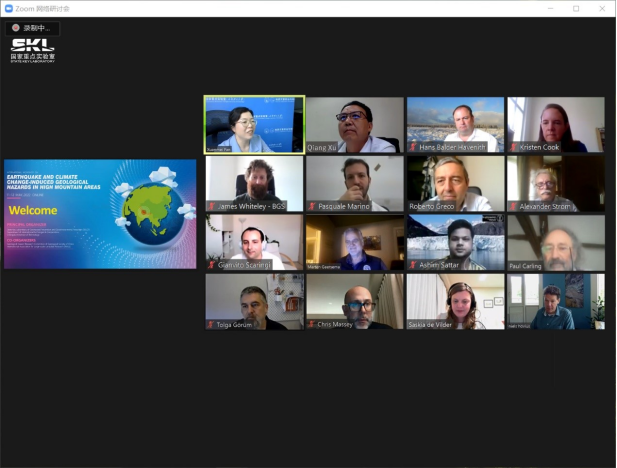
▲Online workshop
At the opening ceremony, Xu Qiang, Vice President of CDUT, extended a warm welcome to the leaders and scholars for their participation in this forum. He said that relying on the Mt. Everest Science Program of our university, he hoped that all participants could use this brainstorm to inspire more scientific research, seek more opportunities for scientific cooperation, and make contributions to further improving the global disaster prevention and mitigation and promoting the construction of ecological civilization.
Fan Xuanmei, Deputy Director of the laboratory, introduced the laboratory's scientific research, equipment, and international cooperation. She said that the laboratory is guided by the needs of national disaster prevention and mitigation and ensuring the safety of major national construction projects. Through the theoretical and technical study on the background, formation mechanism, early identification, monitoring and early warning, and engineering governance of major geological disasters induced by natural and human activities in China, the laboratory strives to form a world-class scientific research center integrating applied basic research, advanced technology development and promotion, high-level talent cultivation and pooling, and international exchanges and cooperation in the field. At the meeting, Fan Xuanmei also sincerely invited outstanding young scientific and technological talents to join the State Key Laboratory of Geohazard Prevention and Geoenvironment Protection through the "Mt. Everest Talent Introduction Program" or overseas excellent youth projects.
On the first day of the forum, Dr. Chris Massey from Institute of Geological and Nuclear Sciences Limited, New Zealand, made a report titled "Post-2016 Kaikoura EQ landscape response to non-seismic processes: An update" and shared with participants the landslide types, landslide distribution and controlling factors, co-seismic landslide provenance and debris volume, etc., which were triggered by the Kaikoura earthquake. Based on the article "Detection and potential early warning of catastrophic flow events with regional seismic networks" published in Science, Dr. Kristen Cook from Helmholtz-Centre Potsdam-German Research Centre for Geosciences (formerly Potsdam Center for Geosciences), introduced the compound chain disasters caused by high-location ice and rockfalls in the Chamoli area in southern Himalayas on February 7, 2021, which caused serious damage to downstream dams, bridges and other infrastructure. The Seismic Network in this area recorded the teleseismic signals generated in the whole process, and proposed a technical method for monitoring and early warning of geological disasters in remote areas using seismic signals. Professor Fan Xuanmei made a report titled "The impacts of climate change on chains of geological hazards on the Tibetan Plateau and its margins", where she presented the latest research progress mainly from the two aspects of the Qinghai-Tibet Plateau geological hazard chain caused by climate change and the geological hazard chain induced by earthquakes.
On the second day of the forum, Prof. Marten Geertsema introduced the major landslide disasters that occurred in British Columbia, Canada and Alaska, USA, where it was found that glacier loss and permafrost degradation jointly led to slope instability and expanded landslide range. Prof. Alexander Strom presented a report titled "Causes and effects of multiple river damming and of the cascading breach of rockslide dams: case studies from Pamir and Minjiang River", where a study is conducted on large landslide dams blocking rivers. The dam-break flood deposits were found thousands of kilometers away downstream, the analysis of the longitudinal profile of the river was proposed to quantify the evolution information of the valley caused by multi-level landslide dams, and it was suggested to carry out the investigation of the dam-break flood deposits. Prof. Niels Hovius from Helmholtz-Centre Potsdam-German Research Centre for Geosciences (formerly Potsdam Center for Geosciences) in Germany presented a report titled "Groundwater as a modulator of mountain geohazards: a case study in the Nepal Himalayas". Based on seismic and hydrological observation data, a groundwater model was used to simulate seismic velocity changes, and finally a time-based concept of geological hazard susceptibility was proposed.
During the two-day international symposium, experts and scholars from all over the world brainstormed and shared contents on the chain of geological disasters induced by strong earthquakes and the chain of cryosphere disasters caused by climate change through 10+ special reports. A total of 1,080 people participated the online meeting. During the exchange, the participants discussed the control factors of post-earthquake landslide and debris flow activity, the duration of post-earthquake effects, and methods of on-site monitoring and early warning of major glacier disasters. Prof. Niels Hovius said that Seismic Networks and its applications will better help monitor and warn geological disasters caused by mass debris migration in remote areas. The forum served as a virtuous continuation of academic seminars such
as the 2021 High-level Forum on Risk Prevention and Control of Geological Environmental Disasters in Mountainous Areas. We hope the forum can help promote more in-depth cooperation and exchange for scholars in the prevention and control of geological disasters induced by earthquakes and climate change in alpine cold regions in the future, and it can also contribute to the further improvement of the global disaster prevention and reduction and the construction of ecological civilization.
▲ A report by Prof. Niels Hovius