SKLGP Landslide Dynamics Team Publishes the Research Result of "Sliding Zone Modulus Weakening and Landslide-trigger Mechanism of Earthquake-triggered Landslides" in the Journal of Geophysical Research: Solid Earth, a Nature Index (NI) Journal
In reliance on a Major Program of the National Natural Science Foundation of China and the Everest Scientific Research Project, the Landslide Dynamics Team of the State Key Laboratory of Geohazard Prevention and Geoenvironment Protection (SKLGP) of Chengdu University of Technology (CDUT) has recently published the research result titled Effect of Amplitude and Duration of Cyclic Loading on Frictional Sliding Instability in Granular Media: Implication to Earthquake Triggering of Landslides in the Journal of Geophysical Research: Solid Earth, together with domestic and foreign scholars, which discovers the instability in granular media after vibration and reveals the sliding zone modulus weakening and landslide-trigger mechanism of earthquake-triggered landslides. The SKLGP of CDUT is the first completion unit for the work, and Prof. Xu Qiang and Prof. Hu Wei of the SKLGP joined hands with scientists from Shanghai Jiao Tong University, GNS Science New Zealand and Institut Langevin Paris to participate in the scientific research and realize the integration of disciplines such as engineering geology, granular physics and rock and soil test mechanics.
Earthquake-triggered landslides are one of the most destructive geohazards, seriously threatening human life and property safety. Take the 2008 Wenchuan earthquake as an example. The more than 60,000 landslides caused the death of about 20,000 people, accounting for one-third of the total death toll of the earthquake. The Wangjiayan landslide in Beichuan County alone caused the death of 1,600 people, being the individual landslide killing the most people since the founding of the People's Republic of China. However, what was the landslide-trigger mechanism for the earthquake-triggered landslide? This scientific question is still unanswered. A series of geomechanical hypotheses have been proposed for the mechanism of earthquake-triggered landslides, but there is still no research on the underlying physical mechanism.
In order to reveal this scientific problem, the Landslide Dynamics Team conducted detailed field investigations into more than ten large landslides triggered by the Wenchuan earthquake, conducted research on the dynamic response characteristics of granular materials and the vibration characteristics of shear modulus, quantitatively analyzed the vibration weakening process of the sliding zone elasticity modulus affected by amplitude and duration, and jointly analyzed the landslide trigger and the sliding zone modulus vibration weakening, to reveal the sliding zone modulus vibration weakening and landslide-trigger mechanism of earthquake-triggered landslides. The research results reveal the underlying physical mechanism of earthquake-triggered landslides and provide an important theoretical basis for quantitative analysis and accurate prediction of earthquake-triggered landslides.
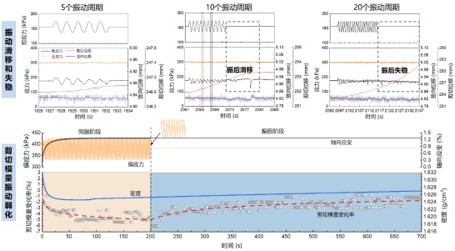
▲Vibration-Slip of Granular Media and Elasticity Modulus Vibration Weakening
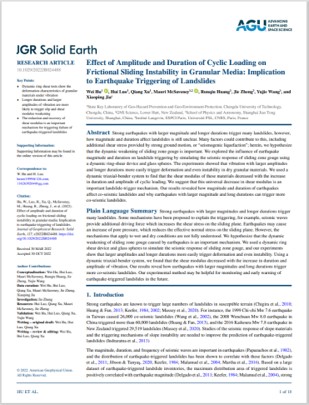
▲First Page of the Article in Journal of Geophysical Research: Solid Earth
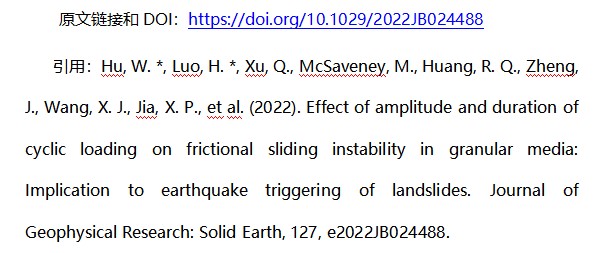
Article link and DOI: https://doi.org/10.1029/2022JB024488
The Journal of Geophysical Research: Solid Earth (JGR: SE) is a flagship journal of the American Geophysical Union (AGU) and is indexed in the Nature Index. It is one of the most influential international academic journals in the field of earth sciences.
Article by SKLGP Landslide Dynamics Team