Inspiring News: A New Mineral "Zhengminghuaite" Named after Our Famous Mineral Deposit Scientist Was Approved
On August 3, 2022, a new mineral jointly declared by China University of Geosciences, Beijing, Beijing Research Institute of Uranium Geology and Chengdu University of Technology with the participation of Associate Professor Dong Shuyi and Associate Professor Peng Yiwei from the College of Earth Sciences, CDUT was approved by the Commission on New Minerals, Nomenclature and Classification of the International Mineralogical Association (IMA-CNMNC) after strict review and voting. The new mineral was named "Zhengminghuaite" in English and “郑明华矿” in Chinese, abbreviated as "Zmh", and numbered IMA2022-047.. The new mineral was actually named after Prof. Zheng Minghua, a well-known mineral deposit scientist at our university, in tribute to his outstanding achievements in the field of mineral deposits, especially in the study of Carlin-type gold deposits. The discovery of the new mineral is a major innovative achievement in the field of mineralogy, which is of great theoretical and practical significance to the development of geological science and the exploitation of mineral resources. Its name, upon approval by the IMA-CNMNC, will be recognized by all countries in the world and recorded in the history of mineralogy.
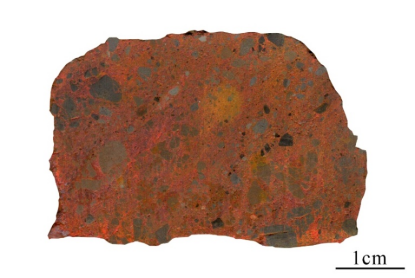
Figure 1 Carlin-type gold ore hand specimens containing Zhengminghuaite in Qianxinan
Zhengminghuaite is a sulfosalt mineral with the crystal formula of Cu6Fe3As4S12, trigonal system, space group R3, cell parameters of a = 13.5373(2) Å, c = 9.2354(1) Å, V = 1465.7(4) Å3, Z = 3. It is a homotype mineral of Cu6Zn3As4S12, Cu6Hg3As4S12 and Cu6Hg3Sb4S12. The new mineral was produced in irregular granular aggregates with particle sizes varying from a few to tens of microns. It is also a gray-black opaque mineral with a Mohs hardness of about 4. Meanwhile, it is a non-homogeneous mineral with an off-white reflective color, a reflectance of 23-29% (546 nm) and weak bireflectance.
Zhengminghuaite was found in Carlin-type gold ore in the southwest of Guizhou Province. Its paragenetic mineral assemblage includes quartz, calcite, realgar, orpiment, pyrite, chalcopyrite, arsenopyrite, aktashite, bitumen, etc. Preliminary studies suggest that such gold ores were precipitated in oil-water immiscible ore-bearing fluids. Sulfosalt minerals are often closely related to medium-and-low-temperature hydrothermal precious metalmineralization, and thus boast a higher diversity and complex paragenetic mineral combinations. The discovery of Zhengminghuaite not only adds a new member to the sulfosalt mineral family, but also has important scientific significance for the study of the mineralization physicochemical conditions and mineralization process of Carlin-type gold deposits. This new mineral was discovered and declared by China University of Geosciences, Beijing (Gu Xuexiang, Zhang Yongmei, Zhang Yingshuai and Li Ling), Beijing Research Institute of Uranium Geology (Fan Guang and Li Ting), and Chengdu University of Technology (Dong Shuyi and Peng Yiwei). This study was funded by the National Natural Science Foundation of China (40772060, 40930423, 42130804 and 42002044).
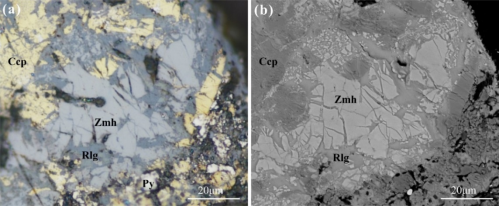
Figure 2 Photographs of reflected single polarized light (a) and back scattered electron (b) of Zhengminghuaite and its paragenetic minerals
Zmh-郑明华矿,Ccp-黄铜矿,Rlg-雄黄,Py-黄铁矿
Zmh-Zhengminghuaite, Ccp-Chalcopyrite, Rlg-Realgar, Py-Pyrite
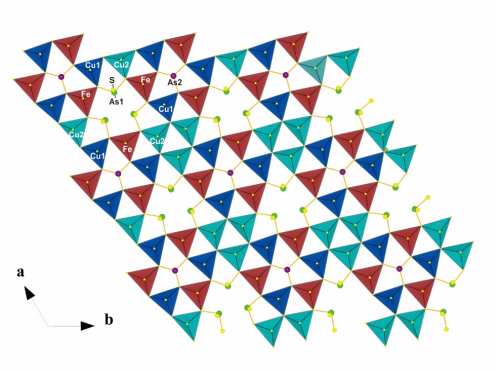
Figure 3 Crystal structure of Zhengminghuaite
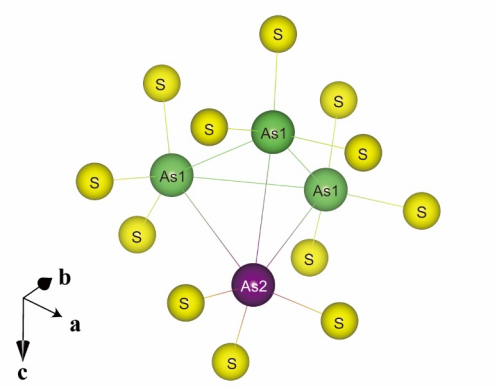
Figure 4 The [As4S12]12-complex anion cluster in the crystal structure of Zhengminghuaite