Recently, the Daocheng Cross-Sphere Monitoring Station, led by a research team headed by Professor Chen Jiehong of the State Key Laboratory of Geohazard Prevention and Geoenvironment Protection at Chengdu University of Technology (CDUT), was officially completed and put into operation. Following the establishment of the Leshan Station in Sichuan and the Qiaojia Station in Yunnan, it has become the world's highest-altitude GOAT MVPLAI Integrated Cross-Sphere Observation Station. The project was jointly undertaken by more than ten universities and research institutions, including Southwest Jiaotong University, China West Normal University, the Daocheng High-Altitude Astronomical Science Center of the Ganzi Tibetan Autonomous Prefecture, Yunnan Observatories, Guilin University of Technology, China University of Geosciences (Wuhan), the Institute of Earthquake Forecasting of the China Earthquake Administration, and the University of Science and Technology of China. The station not only addresses the long-standing gap in three-dimensional geophysical observation capabilities in China’s high-altitude regions and strengthens the foundation for frontier research in deep-Earth and deep-space sciences, but also provides critical scientific and technological support for regional disaster prevention and mitigation, helping safeguard lives and property. Its completion marks a historic leap in China’s multi-sphere Earth observation capabilities, achieving full-chain coverage from “ground-to-sky” to “deep Earth-to-deep space.” The project carries significant national strategic importance, frontier scientific value, and broad societal benefits.
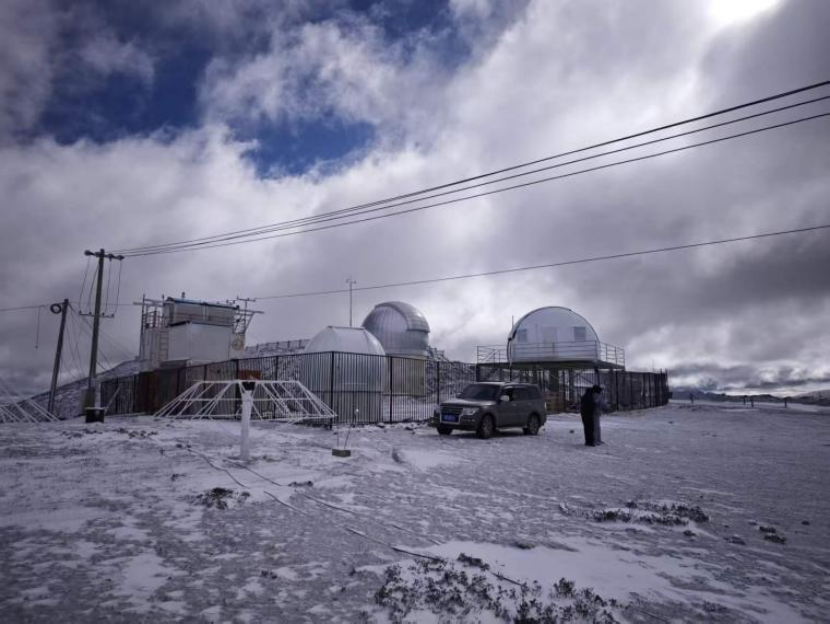
The Daocheng Station is equipped with a full suite of internationally advanced high-precision observation instruments and integrates more than twenty key monitoring parameters, including geomagnetic fields, atmospheric electric fields, magnetotelluric signals, ground vibrations, surface displacement, meteorological variables, radon concentrations, and ionospheric disturbances. Leveraging magnetotelluric sounding technology, the station can accurately probe geological structures down to a depth of 50 kilometers beneath the Earth’s surface. Combined with high-altitude ionospheric monitoring and a newly installed professional astronomical observation system, it is the first facility in the world to establish a comprehensive, multi-scale observation corridor spanning from 50 kilometers beneath the Earth's surface to the Sun and deep space. This achievement has enabled the creation of a new integrated observation framework coupling the lithosphere, atmosphere, ionosphere, and outer space.