Recently, Huang Xiaojuan of the College of Tourism and Urban-Rural Planning at Chengdu University of Technology and her collaborators published a commentary article entitled “The Size of Tropical Vegetation Gross Primary Production” in the Matters Arising section of Nature. The article presents alternative perspectives on a study published in Nature in 2024 by Lai and colleagues concerning estimates of global terrestrial gross primary production (GPP).
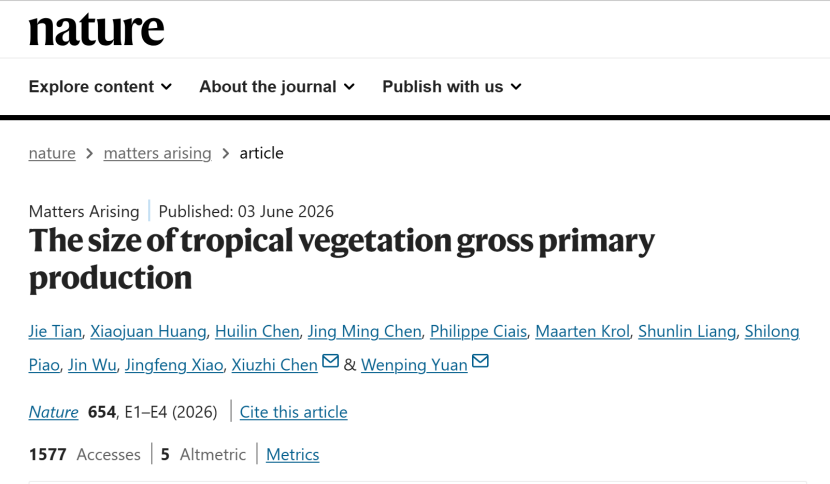
Drawing upon data from the pantropical eddy covariance observation network, multiple remote sensing products, and ecological process analyses, the authors conducted a systematic evaluation of the original study. They argue that substantial uncertainties remain in areas such as model validation, parameterization schemes, and the extrapolation of results to the global scale, and they offer alternative scientific interpretations. The main arguments presented in the commentary include:
1. GPP in tropical regions may have been overestimated.
2. The assumed relationship between LRU (Leaf Relative Uptake) and PAR (Photosynthetically Active Radiation) in the OCS-based method does not account for the influence of VPD (Vapor Pressure Deficit).
3. Relationships derived from a single boreal forest site cannot be directly generalized to tropical ecosystems.
4. The conclusion that satellite remote sensing products systematically underestimate tropical GPP warrants further scrutiny.
The authors of the original Nature paper subsequently responded to these points. Details of the exchange can be found in the corresponding response article published in the same issue of Nature.
Huang Xiaojuan of Chengdu University of Technology served as co-first author of the commentary. Co-authors include Dr. Tian Jie of Sun Yat-sen University and other collaborators. The corresponding authors are Professor Chen Xiuzhi of Sun Yat-sen University and Professor Yuan Wenping of Peking University. The research was supported by the National Natural Science Foundation of China and other funding programs.
Focusing on key scientific questions related to the global carbon cycle and climate change, this study provides new insights into the carbon sink function of tropical ecosystems and the magnitude of global vegetation productivity. The findings contribute to a deeper understanding of terrestrial carbon dynamics and have important implications for improving the accuracy of global carbon cycle assessments.