At the start of the year, Dr. Liang Wendong, a researcher at the Institute of Sedimentary Geology at Chengdu University of Technology (CDUT), published a significant study in Geology, an internationally recognized geoscience journal. His paper, “Contrasting provenance budgets for suspended load and bedload of the Yarlung Tsangpo, Tibet: Lhasa block or Himalaya?”, reveals that different grain sizes in sediment—suspended load and bedload—can record divergent, sometimes contradictory, patterns of material supply and erosion in the watershed. CDUT is the primary institution for the paper, with Dr. Liang Wendong as the first author. The study was funded by the National Natural Science Foundation of China and Second Tibetan Plateau Scientific Expedition and Research Program.
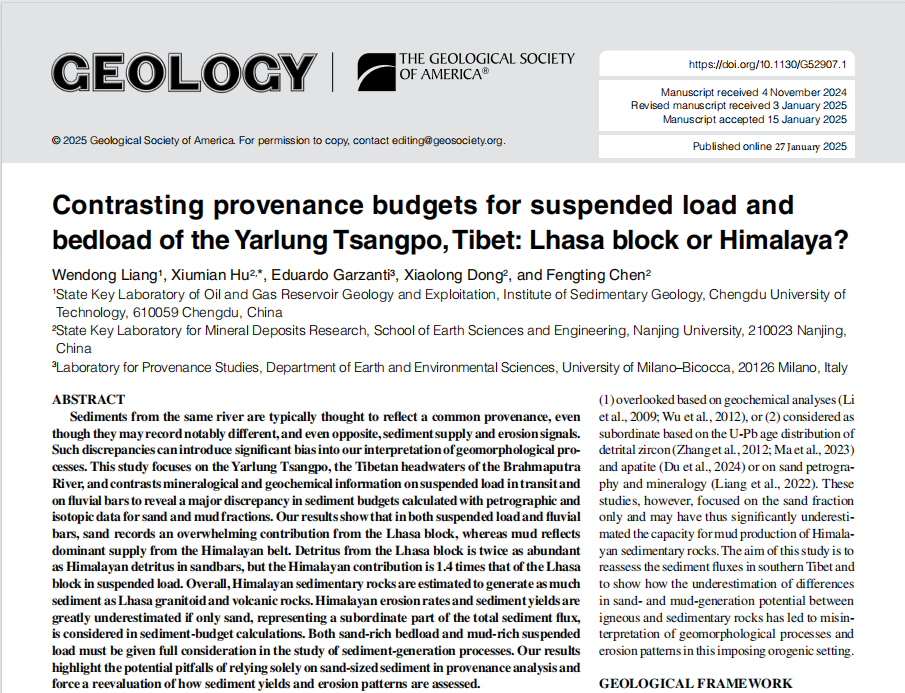
The Published Paper
River sediments are important carriers of information about tectonic activity and climate change in source areas. However, whether river sediments can truly reflect the erosion conditions of source areas remains a subject of debate. Taking the Yarlung Tsangpo River as an example, previous studies, by neglecting the source of muddy sediments, have believed that sediments from the Yarlung Tsangpo mainly originate from the Lhasa block. This has likely significantly underestimated the material contribution from the Himalayan orogenic belt (Figure 1). To address this, the researchers conducted petrographic and isotopic geochemical studies on the sand and mud components of the river’s suspended load sediments. The results revealed that provenance analysis in the watershed is controlled by grain size. Regardless of whether the sediment is suspended load or floodplain deposits, sandy sediments primarily come from the Lhasa block, while muddy sediments mainly come from the Himalayan orogenic belt. Furthermore, the floodplain and suspended load sediments respectively record material supply and watershed erosion signals dominated by the Lhasa block and the Himalayan orogenic belt. The lithological differences between the two sources are the primary reason why the material contribution from the Himalayan orogenic belt has been underestimated.
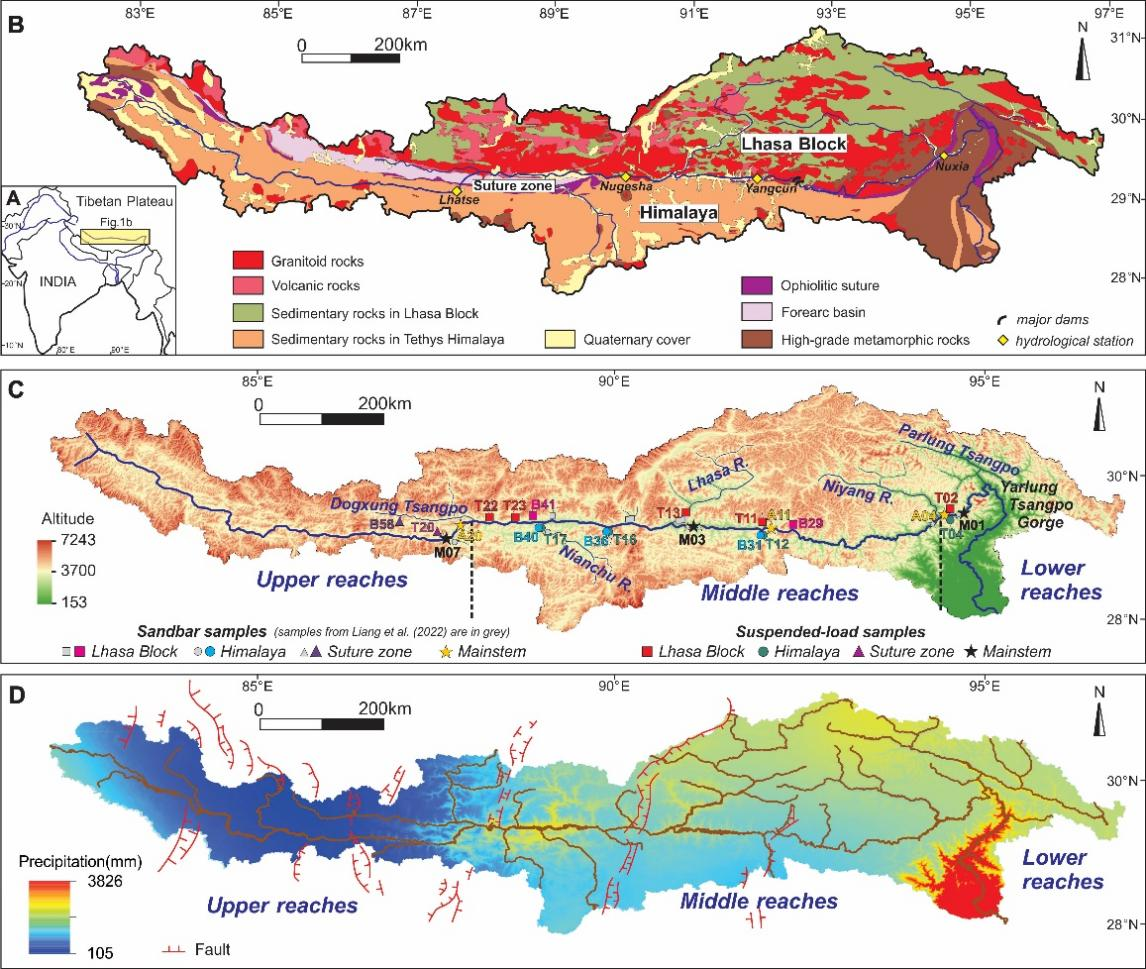
Figure 1: Geographic location (A), geology (B), sampling sites (C), and climate and tectonic overview (D) of the Yarlung Tsangpo River
Dr. Liang’s study not only corrects prior underestimations of the Yarlung Tsangpo’s sediment sources and the erosion rates in the Himalayan orogenic belt, but it also exposes the limitations of relying solely on sand-sized sediments for provenance analysis. The research emphasizes the importance of considering grain-size differences when analyzing sediment sources, especially in regions with stark lithological contrasts. Only by doing so can scientists gain a clearer and more accurate understanding of geological processes and landscape evolution.
Article link: https://doi.org/10.1130/G52907.1
Citation: Liang, W.,Hu, X.,Garzanti,E., Dong, X.,Chen, F. Contrasting provenance budgets for suspended load and bedload of the Yarlung Tsangpo, Tibet: Lhasa block or Himalaya?.Geology 2025.
Geology is a journal published by the Geological Society of America (GSA) and is listed in the Nature Index. It has ranked first for 18 consecutive years in the Web of Science’s geoscience impact factor.