Recently, the ISPRS Journal of Photogrammetry and Remote Sensing, one of the top international journals in the field of photogrammetry and remote sensing, published the latest research findings of Associate Professor Yi Shi’s team on the segmentation of ground surface hot spring fluids using UAV remote sensing: “An interactive fusion attention-guided network for ground surface hot spring fluids segmentation in dual-spectrum UAV images.” Yi Shi, who serves as the paper’s first author, was joined in this research by graduate students Chen Mengting and Wang Jiashuai, with Professors Yi Shi and Guo Ke acting as supervisors. The ISPRS Journal is a highly regarded publication in the field, recognized by the Chinese Academy of Sciences, with the latest impact factor of 10.5. The research was supported by the Sichuan Province Natural Science Foundation (24NSFSC0498) and the National Natural Science Foundation of China (Youth Project, 42407612).
Paper Overview:
Investigating the distribution of ground surface hot spring fluids is crucial for the exploitation and utilization of geothermal resources. The detailed information provided by dual-spectrum images captured by unmanned aerial vehicles (UAVs) flew at low altitudes is beneficial to accurately segment ground surface hot spring fluids. However, existing image segmentation methods face significant challenges of hot spring fluids segmentation due to the frequent and irregular variations in fluid boundaries, meanwhile the presence of substances within such fluids leads to segmentation uncertainties. In addition, there is currently no benchmark dataset dedicated to ground surface hot spring fluid segmentation in dual-spectrum UAV images.
To this end, in the study, a benchmark dataset called the dual-spectrum hot spring fluid segmentation (DHFS) dataset was constructed for segmenting ground surface hot spring fluids in dual-spectrum UAV images. Additionally, a novel interactive fusion attention-guided RGB-Thermal (RGB-T) semantic segmentation network named IFAGNet was proposed in this study for accurately segmenting ground surface hot spring fluids in dual-spectrum UAV images. The proposed IFAGNet consists of two sub-networks that leverage two feature fusion architectures and the two-stage feature fusion module is designed to achieve optimal intermediate feature fusion. Furthermore, IFAGNet utilizes an interactive fusion attention-guided architecture to guide the two sub-networks further process the extracted features through complementary information exchange, resulting in a significant boost in hot spring fluid segmentation accuracy. Additionally, two down-up full scale feature pyramid network (FPN) decoders are developed for each sub-network to fully utilize multi-stage fused features and improve the preservation of detailed information during hot spring fluid segmentation. Moreover, a hybrid consistency learning strategy is implemented to train the IFAGNet, which combines fully supervised learning with consistency learning between each sub-network and their fusion results to further optimize the segmentation accuracy of hot spring fluid in RGB-T UAV images.
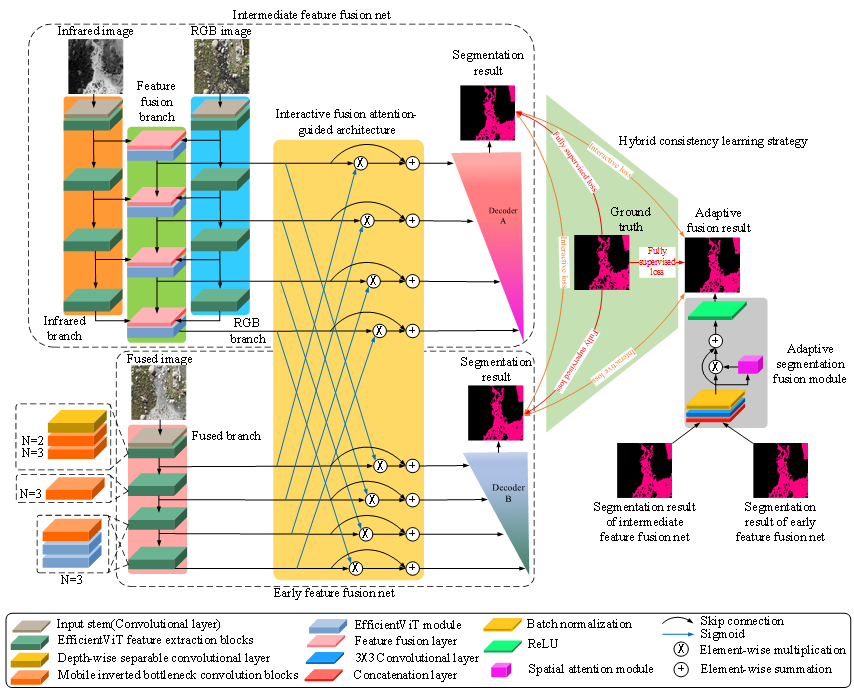
Figure 1: IFAGNet Structure Diagram
The paper provides extensive experimental validation of the proposed network, with results showing that IFAGNet significantly improves the segmentation accuracy of ground surface hot spring fluids in dual-spectrum UAV images, achieving optimal results compared to current similar methods.
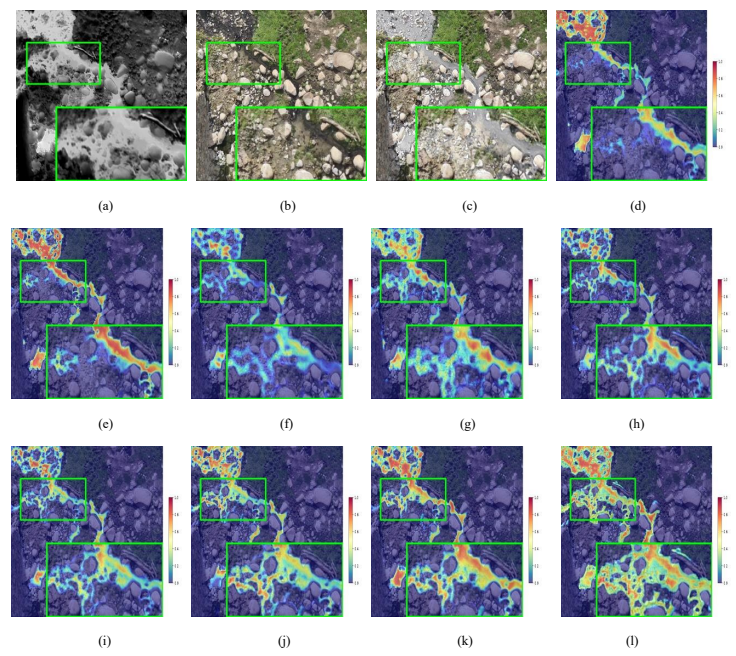
Figure 2: Grad-CAM Activation Map Visualization Comparison (with the final image showing IFAGNet as proposed in this paper)
Paper link: https://doi.org/10.1016/j.isprsjprs.2025.01.022