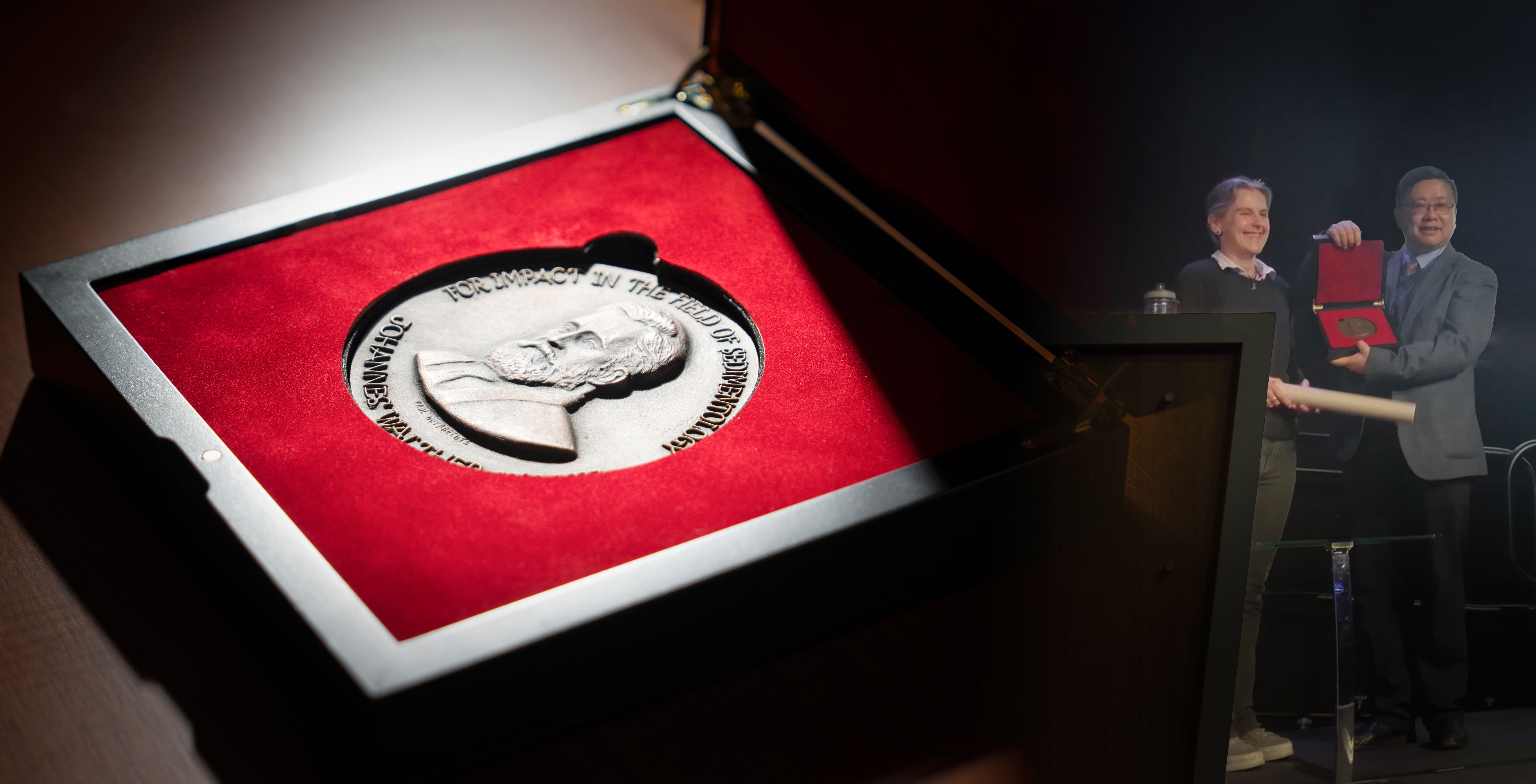
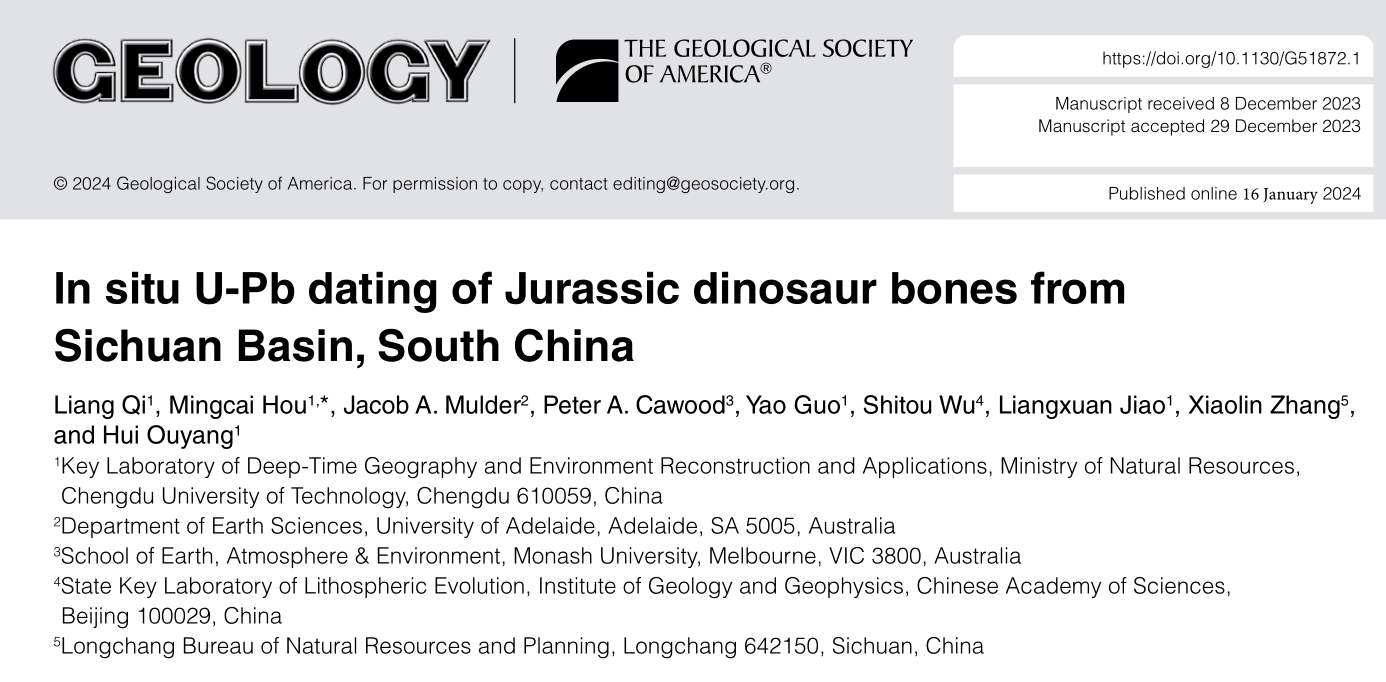
At the beginning of 2024, Professor Hou Mingcai, a member of the Party Committee, Vice President, and the team from the Institute of Sedimentary Geology of CDUT, published the latest research paper In Situ U-Pb Dating of Jurassic Dinosaur Bones from Sichuan Basin, South China in the authoritative international geoscience journal, Geology. This achievement not only provides an innovative research method for high-precision geological dating analysis of vertebrate fossils but also marks a significant breakthrough in the field of dinosaur research in the Sichuan Basin. It offers new clues and perspectives for further exploration of the evolution of life during Earth’s historical periods. The Key Laboratory of Deep-time Geographic Environment Reconstruction and Application of the Ministry of Natural Resources at CDUT is the first completion unit of this paper. Research fellow Qi Liang is the first author, and Professor Hou Mingcai is the corresponding author. The main contributors include renowned dinosaur expert Professor Ouyang Hui, as well as Dr. Jiao Liangxuan and Dr. Guo Yao from CDUT. The research also involved collaboration with Professor Jacob A. Mulder from the University of Adelaide, Australia, and Professor Peter A. Cawood from Monash University, Australia, along with Wu Shitou from the Institute of Geology and Geophysics (IGG), Chinese Academy of Sciences (CAS), and Zhang Xiaolin from the Longchang Municipal Bureau of Natural Resources and Planning.
As is well known, the precise dating of vertebrate fossils has long been a challenge in the academic circles. The commonly used U-Pb dating of biogenic apatite in skeletal fossils is often inaccurate due to susceptibility to interference from late diagenesis. In October 2021, a complete sauropod dinosaur fossil was discovered during quarrying in Longchang, Sichuan Province. It was found in the upper quartz sandstone of the Middle Jurassic Shaximiao Formation, with an estimated body length of about 10 meters. The discovery of this fossil holds crucial scientific importance for gaining a deeper understanding of Jurassic dinosaur ecology and the evolution of life environments. CDUT organized a research team in collaboration with relevant laboratories and experts both domestically and internationally. The team conducted U-Pb dating analysis of the calcite cements in the bone cavities and phosphates of fibrous skeletons within the dinosaur fossil in Longchang, using Laser Ablation-Inductively Coupled Plasma Mass Spectrometry (LA-ICP-MS). The research also involved studies on taphonomy and comparative analyses of dinosaur communities, leading to the following important insights:
1. The burial stratum of the dinosaur fossil is the late Middle Jurassic Shaximiao Formation, Karivian Stage. The diagenetic age of the calcite cements in the bone cavities is determined to be 165.3 ± 3.6/5.6 Ma, consistent with the maximum depositional age of 165.8 ± 1.0 Ma constrained by detrital zircons in the surrounding rocks. This precisely establishes the burial age of the dinosaur at Longchang to be approximately 165 Ma, indicating that diagenesis occurred shortly after the dinosaur’s death, leading to rapid burial and preservation.
2. Comparative analysis of global dinosaur communities reveals that the Jurassic Mamenchisaurus fauna in the Sichuan Basin is much older (approximately eight Ma) than the large sauropod dinosaur assemblages in the North American Morrison Formation and the African Tendaguru Formation. This suggests the possibility of geographical isolation in East Asia during the Jurassic.
3. In contrast to the single isochronous line observed in the calcite cements of the bone cavities, hydroxyapatite in the fibrous skeletal fossils shows a clear system openness. Raman micro-spectroscopy results indicate the existence of nano-scale intergrowth of apatite and organic matter within the fibrous skeletons, which may lead to continuous resetting of the U-Pb system during later diagenesis. Therefore, compared to the biogenic apatite in the bones, dating the calcite cements in the bone cavities holds greater prospects for constraining the burial age of vertebrate fossils, contributing to establishing a more accurate spatiotemporal framework for vertebrate evolution.
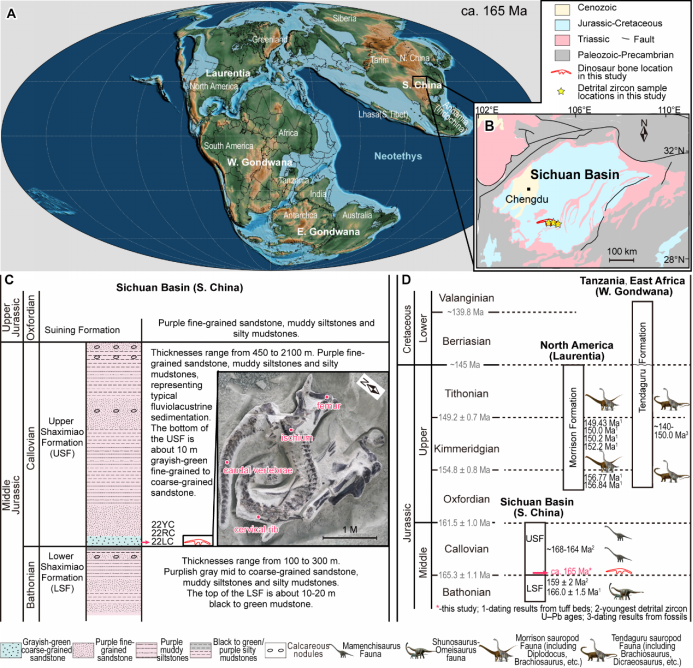
Picture 1: A. Paleogeographic reconstruction around 165 Ma; B. Geological map of the Sichuan Basin with the location of the fossils; C. Stratigraphic column and fossil photos of the Shaximiao Formation in the Sichuan Basin; D. Stratigraphic comparison of the Shaximiao Formation in South China, the Morrison Formation in North America, and the Tendaguru Formation in East Africa.
This research was funded by the Everest Scientific Research Project of CDUT and the Special Fund for the Protection and Finance of Dinosaur Fossils in Longchang. The experimental testing was conducted at the MC-ICP-MS laboratory of the IGG at CAS, the State Key Laboratory of Oil and Gas Reservoir Geology and Exploitation (CDUT), and the State Key Laboratory of Biogeology and Environmental Geology (China University of Geosciences, Wuhan).
Original Publication:
Qi, L., Hou, M.*, Mulder, A. J., Cawood, P. A., Guo, Y., Wu, S., Jiao, L., Zhang, X., Ouyang, H. In situ U-Pb Dating of Jurassic Dinosaur Bones from Sichuan Basin, South China: Geology, https://doi.org/10.1130/G51872.1.
Sponsored by the Geological Society of America and included in Nature Index, Geology has been the top-ranked academic journal in the field of geoscience for 16 consecutive years according to the Web of Science.