Recently, a team led by Zhong Hanting and Wang Xia, two teachers at the Deep-Time Geographic Environment International Research Center of the Institute of Sedimentary Geology (ISG), and accompanied by six research students including Lin Zongqi, Yuan Yi, and Wang Sai, conducted an 81-day project titled “Collection of Multi-source Information and High-Precision Realistic Digitalization of Classic Geological Outcrops in Europe” in nine European countries, including Croatia, Italy, Switzerland, the Czech Republic, Poland, Germany, France, Spain, and Portugal. The project was successfully completed, and the team has returned to China. This project received joint support from the Deep-time Digital Earth (DDE), the Key Laboratory of Deep-time Geographic Environment Reconstruction and Application under the Ministry of Natural Resources, and Chengdu University of Technology (CDUT).
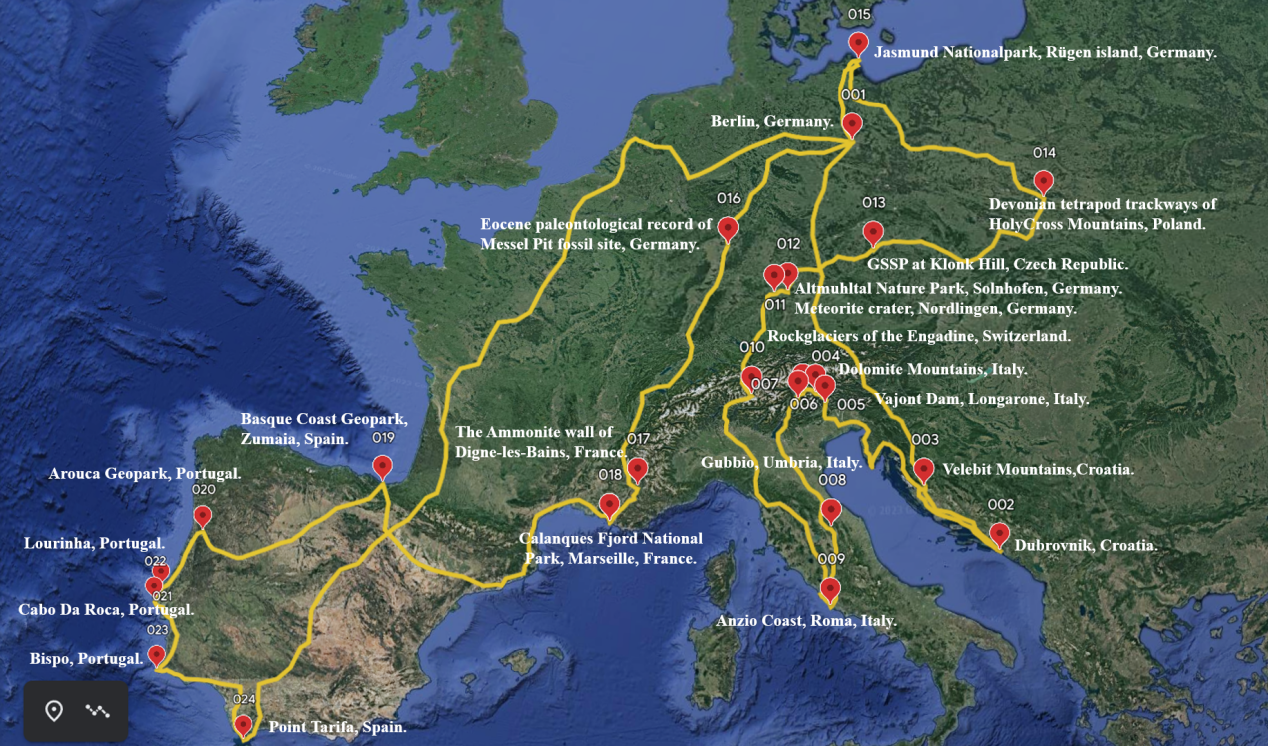
The data collection route of the outcrop3D working group in Europe, which covers a total distance of 17,732 kilometers
It is understood that “the Collection” is an important part of the DDE-Outcrop3D. This batch covers 24 classic geological outcrops in Europe, including Global Boundary Stratotype Section and Point (GSSP, commonly known as “golden spikes”), UNESCO World Geoparks, the first 100 geological heritage sites recognized by IUGS (International Union of Geological Sciences), and field trips associated with the IAS conferences. The main tasks included high-definition 3D modeling of geological outcrops, panoramic photography, and the recording of expert explanation videos. In total, more than 45,000 drone-based 3D modeling photos, over 4,200 panoramic photos, more than 700 expert explanation videos, and a total data volume of 1,600 GB were collected.
The results of this diverse information collection will be showcased on DDE-Outcrop3D (https://outcrop3d.deep-time.org), a digital geological outcrop platform developed by our team led by teachers of CDUT, Zhong Hanting, Chen Jianhua, and Wang Xia. It serves as an integral part of the DDE major platform and currently contains 3D models of 117 geological outcrops from 12 different countries, thus supporting users in freely browsing, commenting, uploading, and sharing content. The platform is internationally advanced in terms of model quality, professional features, openness, and interactivity. Previously, it successfully supported the 21st International Sedimentology Congress’ online field trips and will continue to play a significant role in geological research, education, and public engagement.
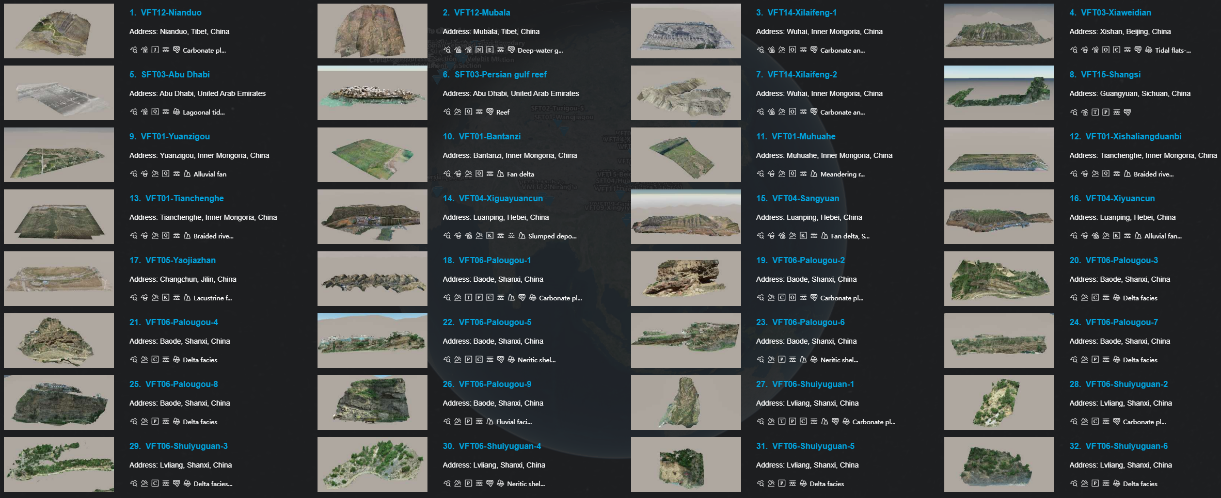
Some of the digital outcrops showcased on the DDE-Outcrop3D platform
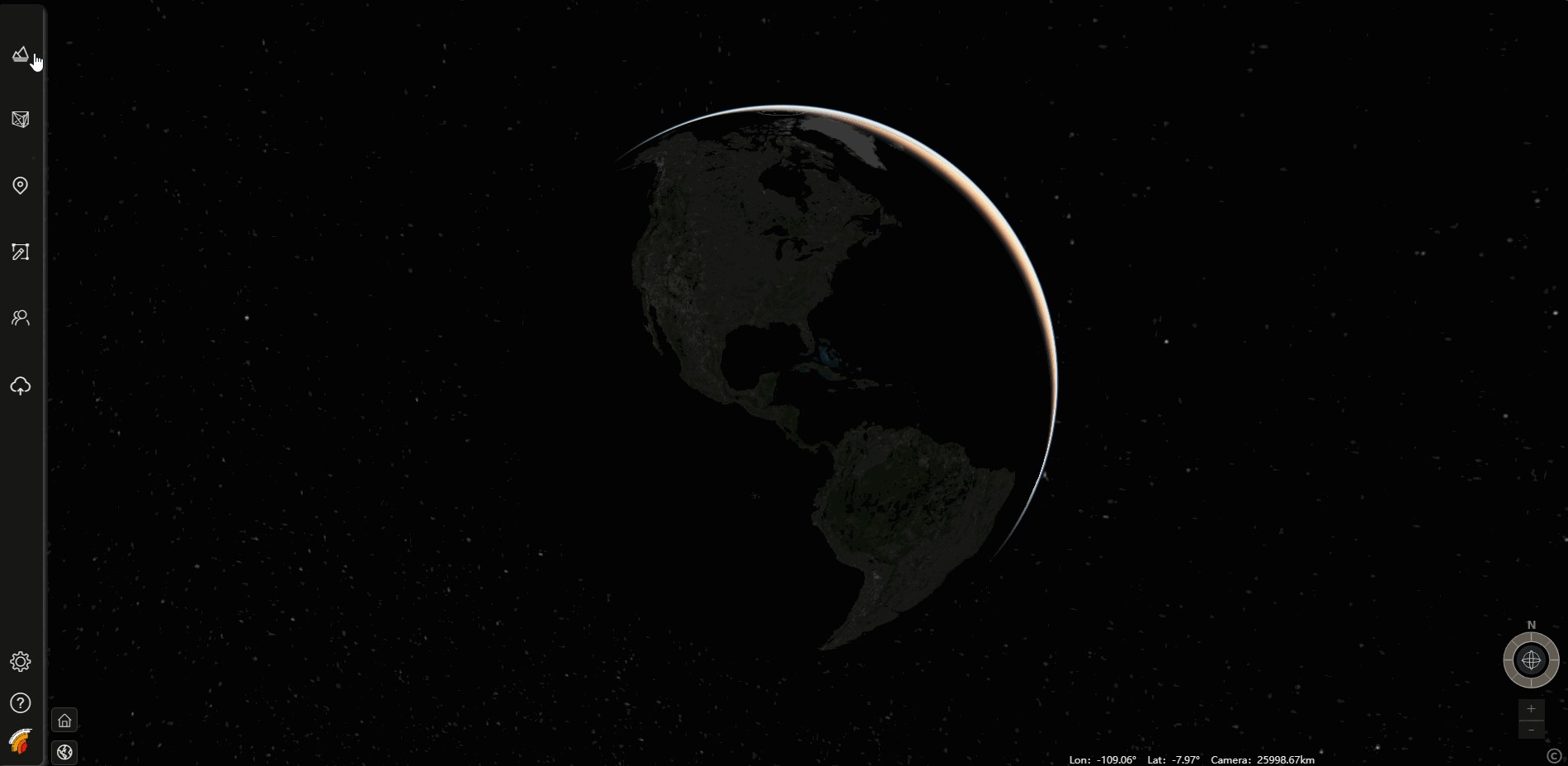
The Bispo section in Portugal, one of the world’s most famous angular unconformity outcrops
During their work in Europe, the faculty and students from the ISG collaborated with 27 international experts and young volunteers from 15 renowned universities and research institutions, including the University of Hamburg and the University of Potsdam in Germany, the University of Perugia and the University of Modena and Reggio Emilia in Italy. Notable experts such as Professor Maria Mutti, Chair of the European Division of AAPG (American Association of Petroleum Geologists), former President of SEPM (Society for Sedimentary Geology), and former Vice President of IAS, and Professor Mauro Soldati, President of AIGeo (Italian Association of Physical Geography and Geomorphology), former President of IAG (International Association of Geomorphologists), highly praised this work and expressed their interest in deeper collaboration with CDUT.
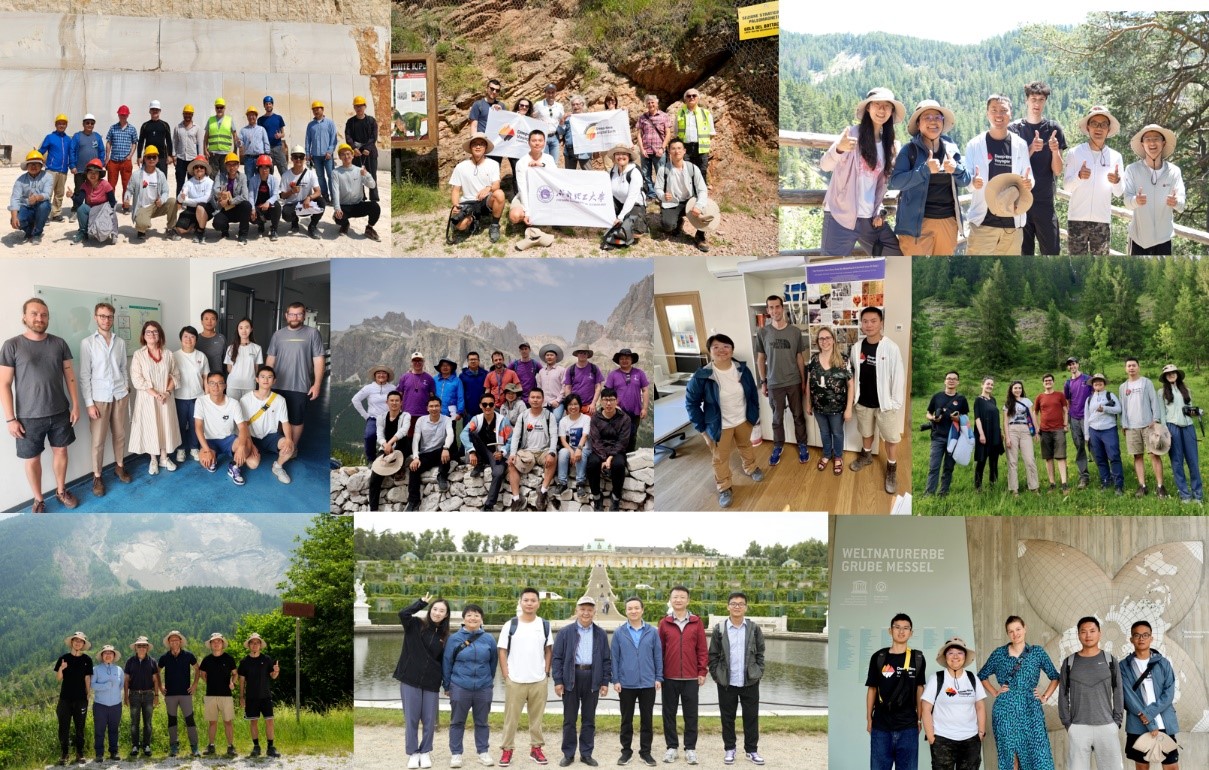
The Outcrop3D Working Group’s Photos with Experts
In recent years, ISG has been actively involved in the international mega-science project led by Academician Wang Chengshan, known as the DDE Project. They have been driving innovation and development in Earth sciences within the era of big data and have achieved a series of groundbreaking results. Afterward, the Outcrop3D Team, led by Zhong Hanting, will continue their efforts in constructing digital geological outcrop platforms and expanding international collaborations. This ongoing work aims to accelerate breakthroughs in fundamental scientific questions related to Earth evolution, ultimately leading to a paradigm shift in the field of Earth science research and industrial applications.