On the morning of December 28, the fifth meeting of the second Academic Committee of the State Key Laboratory of Geohazard Prevention and Geoenvironment Protection (hereinafter referred to as the lab) was held in meeting room 318 in the lab. Academician Wang Sijing, Academician Cui Peng, Academician Peng Jianbing, Vice Minister of Ecological Environment and Director of the lab, Huang Runqiu, the Party Secretary of the University, Gong Hao, Vice President, Deputy Director of the lab, Xu Qiang, and members of the Committee, as well as heads of related colleges and functional departments of the University gathered together to draw a blueprint for the lab’s development in the next five years.
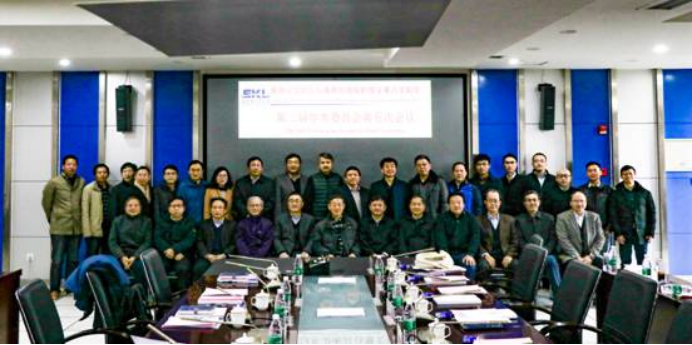
Group Photo of Leaders, Experts
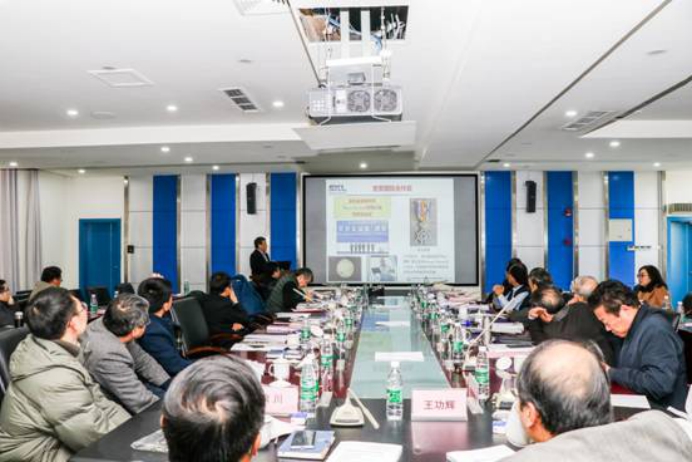
In the Meeting
Gong Hao gave a welcome speech on behalf of the school. He expressed his gratitude to Vice Minister Huang Runqiu, Academicians, experts and scholars for their long-term care and support to the university. He expressed his expectation that the lab could make more and greater achievements, and wished the conference a complete success.
Xu Qiang made a comprehensive report to the Committee on the work progress of the lab in 2019, reviewed the work of the lab over the past five years. In recent years, the lab adhering to the development concept of "being the academic frontier, operating internationally and socializing research results", had made significant achievements in scientific research, personnel training and other fields in accordance to the goal of "cultivating first-class scientists, having a first-class international performance, and achieving the first-class results", upholding to the academic thoughts system of "geology process mechanism analysis-quantitative analysis" and "systematic engineering geology", and had won dozens of important awards including the Second Prize of National Award for Science and Technology Progress, the First Prize of Sichuan Provincial Award for Science and Technology Progress.
In the past five years, the lab has gathered a number of outstanding young and middle-aged scientists in this field, established a "1 + 10" team (1 innovative research group + 10 stable scientific research teams with distinctive characteristics), and implemented a trinity of lab-team-individual in scientific research organization. The lab has undertaken 909 scientific research projects, with a total budget of more than ¥590 million. It has made great achievements with some important theories and technical innovations in the hazard mechanism, dynamic characteristics, monitoring and early warning, prevention and control of collapse, landslide, and debris flow, promoting the development of engineering geology and elevating China’s international standing on engineering geology; a number of major geohazards have been evaluated, predicted and successfully disposed, ensuring the safety of more than tens of thousands of people in 50 towns; 2191 academic papers have been published, including 678 SCI papers. Also, the international famous journal Nature made a report on the lab’s achievements in the study of formation and evolution dynamics of high-speed long-distance landslides.
As an important talent base and international exchange and cooperation base in the field of geohazards in China, the lab has attracted 38 Doctors to carry out postdoctoral research in the past five years, recruiting 11 overseas postdoctoral researchers, 199 doctoral candidates and 1364 postgraduate students. 3 international academic conferences have been hosted, and 5 have been cosponsored. 4 courses of iRALL international doctoral training have been independently sponsored, which provided "large landslide field data collection, monitoring and modeling" training to more than 130 doctoral students from all over the world.
After listening to the report, Academician Wang Sijing led the academic committee to review the 2019 work report and the five-year work report. He pointed that the lab had achieved much more progress in recent years than expected. Based on scientific thinking and vision, combined with practice, researches solved practical problems, completing the first step transferring scientific research results to engineering application, promoting the development of the discipline. He stressed that the lab should continue to play a leading role, accelerate the cultivation of innovative talents, pay attention to the development of talent teams, and realize the transformation from science to technology, and the integration and development of science, technology and engineering as soon as possible.
Academician Cui Peng and Academician Peng Jianbing fully affirmed the development goal of establishing a platform with international vision, international concept and international operation, carrying out substantive international cooperation, cultivating international talents and improving international influence in the next step. They also put forward some constructive suggestions on strengthening the lab's work in scientific and technological innovation, theoretical research, engineering application, etc. Prof. Shi Bin, Prof. Chen Jianping, Prof. Wang Gonghui, Prof. Li Xidi, Prof. Song Shengwu, Prof. Tang Huiming, Prof. Tang Chuan and other committee members also conducted in-depth discussion on the lab’s development and research direction.
Huang Runqiu, Director of the lab, made some closing remarks. He thanked the experts for their suggestions and opinions. He believed that we should use the current achievements as the motive force to promote the high-level development of the lab in the future, and put forward clear requirements for the developing the lab from four aspects: first, we should keep up with the development trend of the time, pay attention to the nation’s strategic requirements, refine the research characteristics, and clarify the research core and spirit soul; the second is to seek the breakthrough of original scientific and technological innovation, and seek the qualitative change of scientific research results from zero to one; the third is to increase the transformation of scientific research results, transform theoretical results into industry codes, guidelines and standards, and promote the socialization of results; the fourth is to maintain the advantages and characteristics of engineering application, strengthen the assessment of quantitative standards, and constantly improve the level and influence of lab’s basic research.