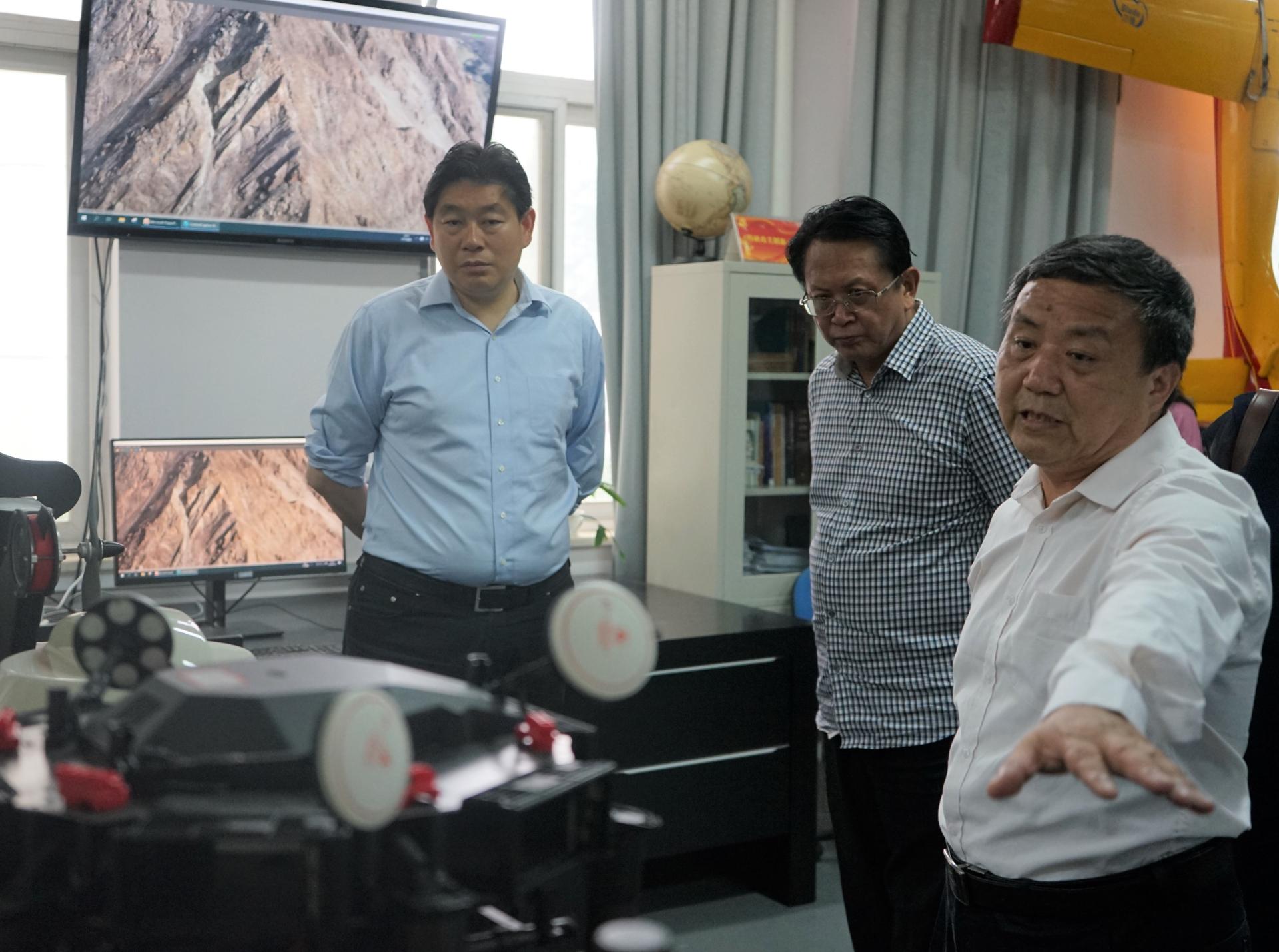
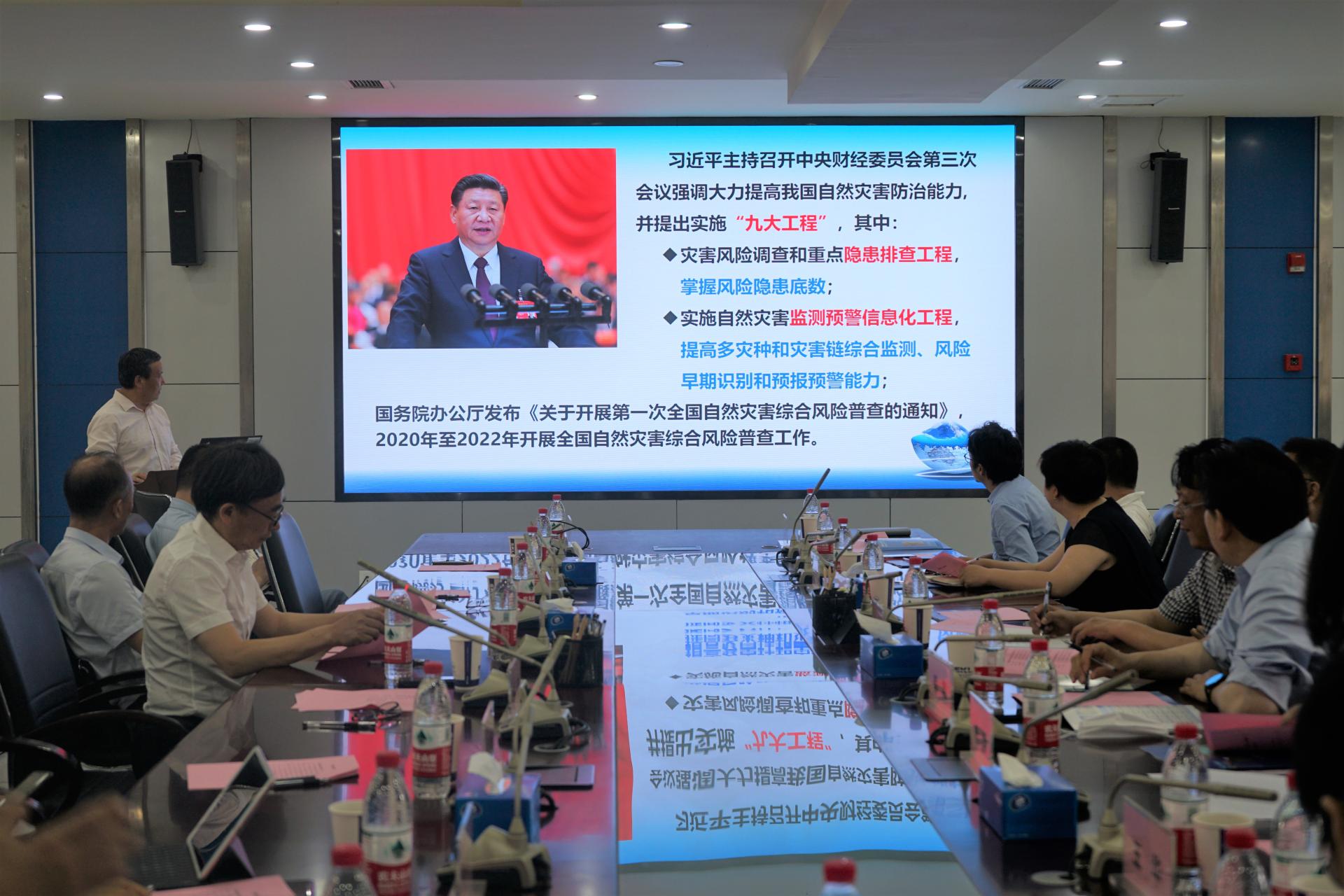
On the morning of June 12, Ge Sang, secretary of party leadership of department of Economy and Information Technology of Tibet Autonomous Region, and Guo Xiang, deputy director of the department and others, accompanied by Wang Shizhong, director of the Sichuan Institute of National Defense Science and Technology Information and others, visited our school for investigation and held a symposium. Liu Qingyou, deputy secretary of the CPC Committee and President of Chengdu University of Technology (CDUT), and Xu Qiang, vice president, attended the symposium. The heads of relevant units of the school attended the meeting.
At the meeting, Xu Qiang, the Vice President, extended a warm welcome to Secretary Ge Sang and his party on behalf of the school, and introduced the basic situation of CDUT and the related research carried out by the SKLGP on the prevention and control of geological disasters and the evaluation and restoration of ecological environment on the Qinghai-Tibet Plateau. Xu Qiang pointed out that the Qinghai Tibet Plateau, as an important ecological security barrier and strategic resource reserve in China, has been paid more and more attention by our country and academic circles. In particular, in terms of geological disaster prevention and control, there are “high location and difficult to find”. In view of the identification, monitoring and early warning of high-level hidden landslides in western mountainous areas, the researchers of the laboratory has put forward a “three-check system”(that is, to identify and discover the hidden dangers of major geological disasters in advance from three dimensions: space, sky and ground) to identify potential hazards in the early stage, and has established a real-time monitoring and early warning system for geological disasters, which has successfully forewarned many landslide events. At the same time, our university launched the “Everest Scientific Research Plan” on November 24, 2019, gathering top experts and scholars in related fields at home and abroad, and conducting research on a series of scientific issues concerning the complex geological process the effects of resources and environment on the Qinghai-Tibet Plateau and its surrounding areas its surrounding areas. We hope to strengthen cooperation and exchange with the department of Economy and Information Technology of Tibet Autonomous Region and establish a geoscience research base with international influence in Tibet, which will produce a number of world-class results.
President Liu Qingyou further stressed that our school’s main research focus will be on the Qinghai-Tibet Plateau and its surrounding areas. We hoped that through further cooperation and exchanges with relevant departments of the Tibet Autonomous Region, we can make full use of the advantages of relevant disciplines to build a monitoring and early warning system for geological disasters and ecological environment in the whole process, so as to support the sustainable development and ecological civilization construction in the Qinghai-Tibet Plateau region and serve the country’s major strategic needs and major project construction.
Guo Xiang, deputy director of the department, pointed out that they hoped to learn from the advanced experience and practice of Sichuan Province and promote the informatization construction of Tibet through this investigation. At the same time, he highly affirmed the relevant scientific and technological achievements made by our school and praised the strong scientific research force, with high level and wide application, which will surely provide strong support for the geological disaster-related work in Tibet, and expressed full confidence in the further cooperation between the two sides. He added that the Tibet Autonomous Region is currently working out a plan for early warning, monitoring of geological disasters and emergency response plan and hopes that CDUT will provide strong support.
Secretary Ge Sang expressed his gratitude for the support provided by CDUT. Although the time for this visit was short, the results were fruitful, providing relevant researchers with insight for the prevention and control of geological disasters in Tibet in terms of monitoring and early warning, emergency management, information management, etc. He hoped that through further in-depth discussions and exchanges between the two sides, the governance system and governance capacity building of relevant departments in Tibet Autonomous Region could be improved in the future.
Later, Professor Ju Nengpan gave a detailed introduction to the geological disaster monitoring and early warning system independently developed by our laboratory. The two sides held in-depth discussions on scientific research and application demonstration of geological disaster prevention and control as well as on serving the informatization construction in Tibet.