SKLGPGP's Another Publication on EPSL Reveals the Mechanism of Fluid-like Long Run-out Motion of Landslides
In 2019, the landslide control research team of the State Key Laboratory of Geohazard Prevention and Geoenvironment Protection (SKLGPGP) of Chengdu University of Technology published a paper on the Earth and Planetary Science Letters (EPSL), which accurately determined the temperature of high-speed and long run-out landslide slip zone for the first time and found the microscopic evidence of the landslide slip surface generating high temperature due to frictional heat and vaporizing the rock mass. The relevant results were featured and classified as a global research hotspot in the Nature.
Recently, the research team published another latest research paper titled The Intrinsic Mobility of Very Dense Grain Flows on EPSL, which introduces grain physics into landslide research and presents a new understanding of the mechanism of super strong fluid-like motion of high-speed and long run-out landslides through multidisciplinary approach.
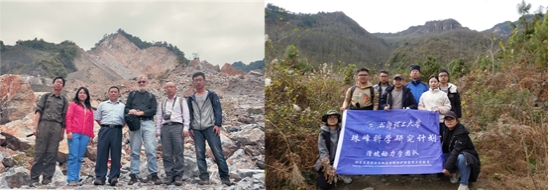
Figure 1 Landslide control research team making a site visit at Shanyang landslide and Qingchuan Donghekou landslide in Shaanxi
Numerous examples show that some landslides can move a long distance with huge speed, which is called high-speed and long run-out landslide. The movement speed of high-speed and long run-out slide can reach up to 278 m/s, which is equivalent to the cruising speed of an aircraft. After a landslide occurs, it can move like a fluid for tens of hundreds of kilometers over a long distance (see Figure 2). The ultra-high sliding (movement) speed, ultra-long distance and ultra-mobility make landslides extremely destructive and often lead to catastrophic accidents (see Figure 3), which has become a research hotspot in the international landslide research community. The landslide control research team of the SKLGPGP has been exploring the mechanism of landslides with high-speed and long run-out in an attempt to unravel the mystery of the causes. Based on the indoor high-speed and high-pressure grain flow experiments, the team has introduced the theory of grain physics into engineering geology and revealed the mechanism of "fluctuation and drag reduction" of high-speed and long run-out landslide debris flow - elastic wave grain vibration drag reduction mechanism. The study of high-speed and long run-out landslide mechanism has been a hot topic and a frontier scientific issue in the field of international geoscience and engineering geology.
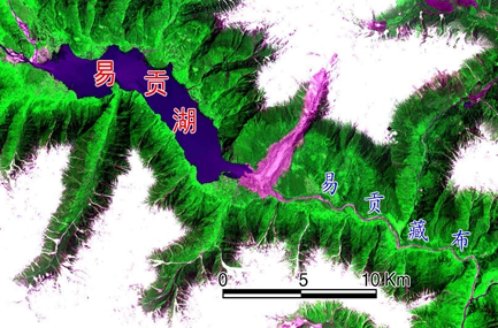
Figure 2 Yigong landslide in Tibet with horizontal movement of up to 8km in 2000
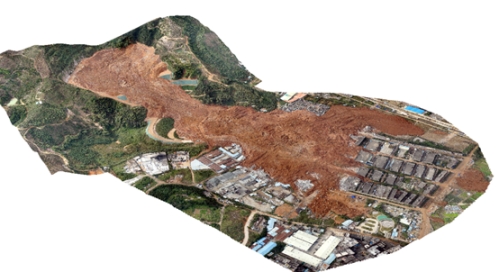
Figure 3 Landslide at a dump receiving site in Guangming New District, Shenzhen in 2015, causing 33 buildings to be buried or damaged
Why can a landslide that is a solid substance move like a fluid over long distances? How do solids actually transform into fluids?
Around this scientific issue and by means of indoor high-speed rotary shear experiments, the research team discovered that: high-speed crushable grains have super-weakening characteristics and their physical mechanism of super-weakening was found to be caused by the vibration drag reduction of elastic wave grains. Besides, some peculiar physical phenomena occurred during the experimental process, such as variable acoustic signals, special grain configuration and peculiar chatter-marked scratches.
There were variable acoustic signals. At the point of mechanical weakening, the acoustic emission signal generated by the high-speed granular flows is abruptly attenuated. Acoustic anisotropy provides direct evidence of the weakening of elastic wave grain vibrations (see Figure 4).
There was special grain configuration. The observation with high magnification SEM reveals a special grain configuration of the granular fluid that: a large number of nanograins were produced during shearing and large grains were wrapped by nanograins. The special grain configuration provides the grain body configuration conditions for the grain flow weakening (see Figure 5).
There were peculiar chatter-marked scratches. The observation with SEM in relation to the surface microstructure of the grains after the experiment reveals peculiar chatter-marked scratches. These chatter-marked scratches were produced by stick-slip marks from small grains moving on relatively larger grains, which is the physical mechanism of elastic fluctuations inside the grains (see Figure 6).
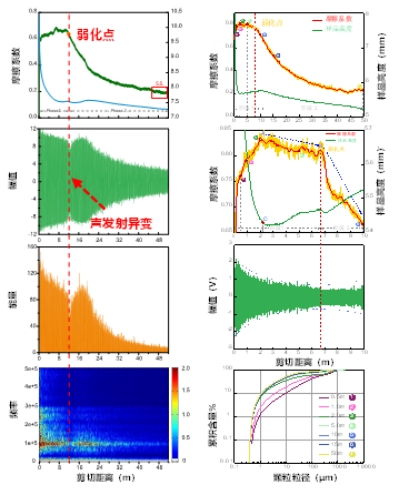


Figure 4 Variable acoustic signals
Figure 5 Special grain configuration
Through the analysis of the above three physical phenomena, the team found the intrinsic mechanism of the super mobility of high-speed and long run-out landslide that: the grains slide with each other during high-speed shearing process, forming chatter-marked scratches and elastic waves on the surface of the grains, while elastic waves travel inside the grain, so that high-speed and high-pressure grain fluid is in the high-frequency elastic wave field, greatly reducing the inter-grain contact stress, resulting in a sharp reduction in the friction coefficient and grain fluidization. This phenomenon is called the "elastic wave grain vibration drag reduction" effect (see Figure 7).
Figure 6 Peculiar chatter-marked scratches
Figure 7 "Fluctuation drag reduction" effect published in EPSL
There are still many peculiar phenomena of high-speed and long run-out landslides that have not been explained scientifically and rationally. The landslide control research team of Chengdu University of Technology will rely on the excellent experimental instruments and equipment of the SKLGPGP, innovate on the basis of what has worked in the past, continue to explore and unravel the mystery of the causes of high-speed and long run-out landslides, and provide scientific and theoretical support for the prevention and control of major landslide disasters in China.