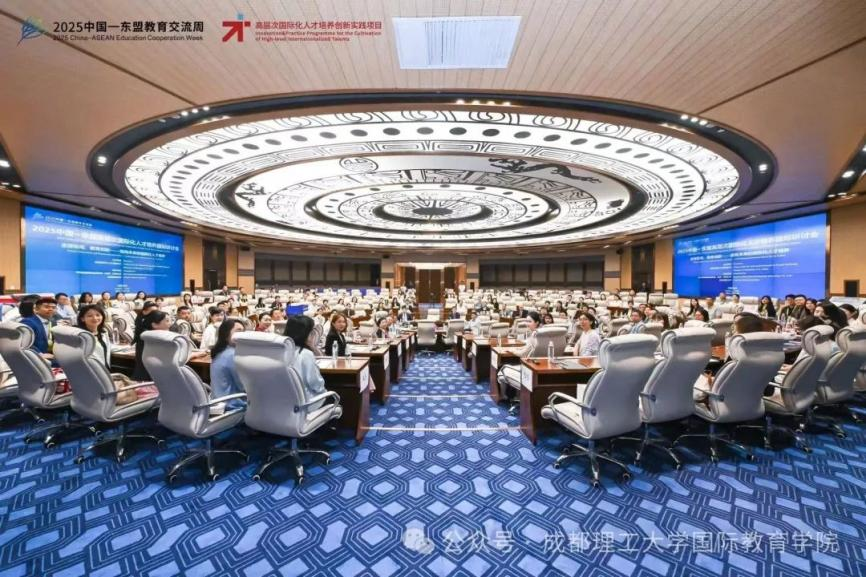
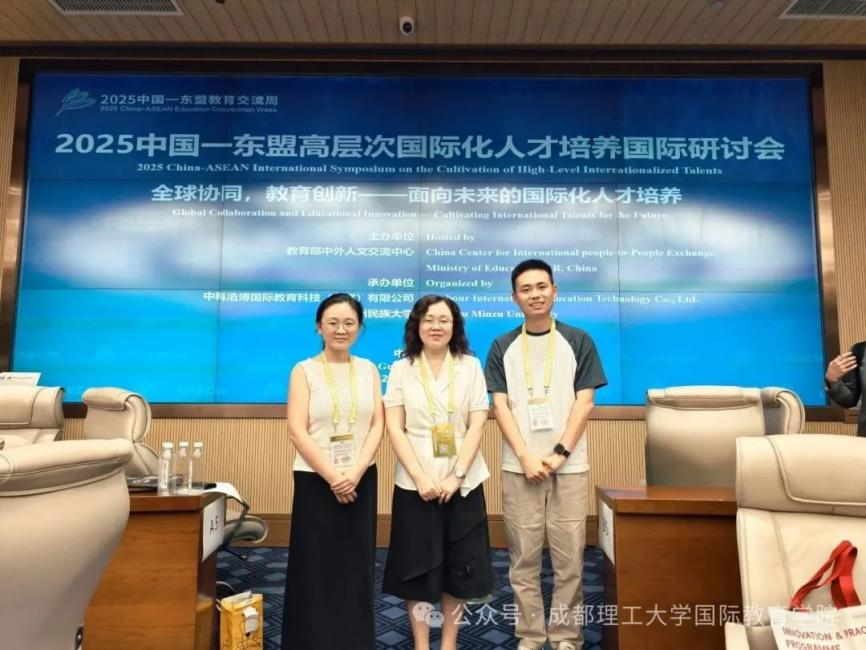
From July 24 to 27, 2025, the China-ASEAN Education Cooperation Week was held in Guiyang. A delegation from the College of International Education (Oxford Brookes College) at Chengdu University of Technology (CDUT), led by Dean Li Shan, was invited to attend the International Symposium on the Cultivation of High-Level Internationalized Talents, hosted by the China Center for International People-to-People Exchange under the Ministry of Education. With the theme “Global Collaboration and Educational Innovation—Cultivating International Talents for the Future,” the symposium brought together experts and scholars from universities, educational institutions, government agencies, and international organizations across China and ASEAN countries.
Focusing on Global Transformation: Building a Collaborative Talent Ecosystem
The symposium officially opened on the morning of July 25. Mr. Yu Changxue, Director of the China Center for International People-to-People Exchange, shared the center’s vision and practices regarding the cultivation of high-level international talent. He emphasized the need for collaboration between Chinese and international stakeholders to explore innovative approaches to talent development, aiming to nurture globally-minded professionals who can contribute to the reform and construction of global governance systems.
Following the opening ceremony, several renowned experts delivered keynote speeches. They provided in-depth analysis of the profound transformations and challenges facing global education and explored how universities can actively adapt to these changes. Discussions highlighted the importance of embracing new ideas, reforming educational models, and integrating resources to establish an open, inclusive, and innovation-driven ecosystem for developing international talent that can support regional and global sustainable development.
Building Consensus: Exploring New Pathways for Talent Development
During the roundtable session, participants engaged in constructive dialogue centered on the theme: “How Can International Cooperation Advance the Development of Future-Oriented Global Talent?” Drawing from their countries’ and institutions’ practical experiences, attendees reached a consensus that cultivating global talent for an increasingly complex future requires breaking through traditional boundaries and deepening substantive international cooperation.
Tailored Solutions: Advancing University-Level Internationalization
A special session titled “One University, One Strategy” provided institutions with targeted expert consultation. Dean Li Shan delivered a comprehensive overview of CDUT’s history, disciplinary strengths, current progress in international exchange and cooperation, as well as existing challenges. She further elaborated on the university’s ongoing efforts and strategic thinking in cultivating high-level international talent.
Following her presentation, experts including Prof. Wang Zhijia (Advisor at Tongji University, former Director-General of the Department of International Cooperation at the State Environmental Protection Administration, and former Deputy Director of Regional Cooperation at the UN Environment Programme), Mr. Sun Jianning (former Deputy Inspector of the Shaanxi Provincial Department of Education), and Ms. Sun Zhongwen (President of Harbour International Education Technology Co., Ltd.) offered insightful and constructive guidance tailored to CDUT’s context. The experts affirmed CDUT’s achievements in internationalization and provided valuable suggestions for optimizing its high-level international talent development system.
The symposium featured a clear theme, rich content, and fruitful outcomes. It served not only as a platform to learn from leading international practices and showcase institutional achievements, but also fostered in-depth exchanges with global experts. This broadened perspectives and built consensus on deepening the internationalization of education and optimizing high-level talent development pathways.
Moving forward, the College of International Education will leverage this symposium as a springboard to further explore open, collaborative, and innovative models for global talent development. It will strive to cultivate more professionals with global vision, cross-cultural competencies, and the ability to engage in international cooperation and competition.