Following the online cooperative dialogue held on September 11, the second round of cooperative dialogue between CDUT and the University of Santiago, Chile, took place on the evening of October 14. The meeting was attended by Lang Xianguo, Director of the Department of International Exchanges & Cooperation and Party Secretary of the College of International Education; Liu Yongzhi, Dean of the College of Foreign Languages & Cultures; Leonora Mendoza, Vice President for Academic Affairs at the University of Santiago; Cristina Moyano, Dean of the Humanities Faculty; Fernando Olmos, Director of International Affairs; Sun Xintang, Director of the Latin American Language and Culture Center at Beijing Language and Culture University (BLCU); and Fabián Pizarro, Head of Multimedia for “Efecto China” in Chile. The session was chaired by Sun Xintang.
Lang Xianguo expressed his gratitude for the presence of the leadership from the University of Santiago and provided a comprehensive overview of CDUT’s development, offered programs, academic research, and international education initiatives. He emphasized that this meeting, aimed at further discussing Chinese language courses and the cooperation agreement, not only advanced substantive collaboration but also established a strong foundation for joint research and exchanges among faculty and students.
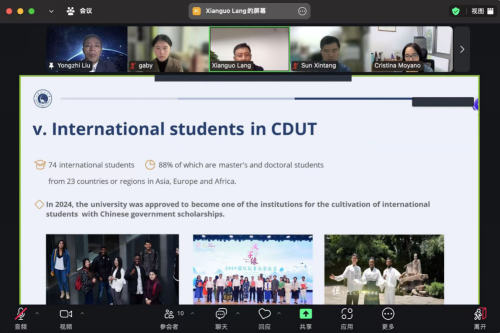
Lang Xianguo presenting an overview of CDUT
Cristina Moyano expressed her appreciation for Lang’s introduction, highlighting that the Humanities Faculty is responsible for foreign language instruction across the University of Santiago. She noted that the introduction of Chinese language courses would provide students with more options and support the University of Santiago’s mission to cultivate versatile international talent. Fernando Olmos provided an overview of the geographical location, development status, international student body, and international exchanges at the University of Santiago. He emphasized that the International Affairs is dedicated to establishing cooperative relationships with renowned universities globally and expressed confidence that collaboration with CDUT would further enrich academic and cultural interactions between the two countries. Following this, Leonora Mendoza remarked that the comprehensive introductions from both sides reveal a high degree of similarity in their academic disciplines, presenting vast opportunities for collaboration. She emphasized that as the second most spoken language globally, Chinese is increasingly influential, and she hoped to expedite the implementation of the Chinese language course plans, using this as a foundation for multifaceted and in-depth cooperation between the two universities.
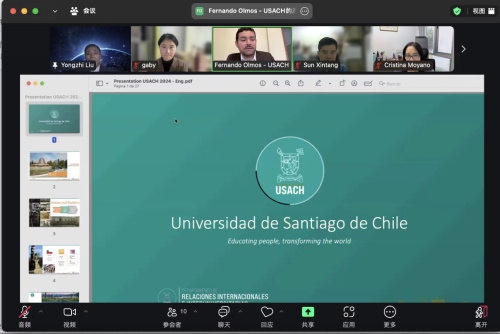
Fernando Olmos presenting an overview of USACH
Liu Yongzhi, representing the implementation unit of the Chinese language courses at CDUT, noted that the College of Foreign Languages & Cultures has a similar academic background to the Humanities at the University of Santiago, as both are responsible for foreign language education for all students. The College is committed to providing comprehensive support for the implementation of Chinese language courses, ensuring the smooth delivery of overseas Chinese language instruction. Following this, Liu Hao, a staff member from the Department of International Exchanges & Cooperation, offered an overview of the draft cooperation agreement between CDUT and the University of Santiago. He welcomed any proposed amendments from the University of Santiago to facilitate the final signing of the agreement. Fernando Olmos provided suggestions for revisions, and both parties pledged to clarify the agreement’s content through further communication, addressing legal responsibilities, intellectual property rights, and other details.
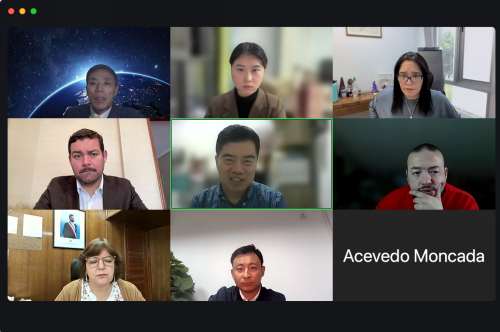
The Cooperative Dialogue
The second round of cooperative dialogue between CDUT and the University of Santiago, outlined the potential areas and directions for collaboration, marking the beginning of practical cooperation in overseas Chinese language education, research collaboration, and personnel exchanges. Both universities are committed to actively advancing these initiatives, contributing to cultural and technological exchanges between China and Latin America.