Recently, the Intelligent Paleogeographic Reconstruction Team led by Professor Hou Mingcai, Vice President of Chengdu University of Technology, achieved a major breakthrough in deep-time climate research. Their latest study, entitled “Tight Regulation of Earth's Long-Term Temperature over Phanerozoic Time,” was published in the internationally renowned journal Nature Communications. By innovatively integrating geoscience big data with climate model data assimilation techniques, the team reconstructed the evolutionary history of Earth’s global mean temperature throughout the Phanerozoic Eon—spanning approximately 540 million years—and provided critical evidence for understanding the mechanisms that have maintained Earth’s long-term habitability.
The study was led by Associate Professor Zheng Dongyu of Chengdu University of Technology as the first author. Professor Hou Mingcai and Professor Benjamin J. W. Mills of University of Leeds served as corresponding authors. The research involved collaboration among multiple domestic and international institutions and was supported by several national, provincial, and ministerial research funding programs.
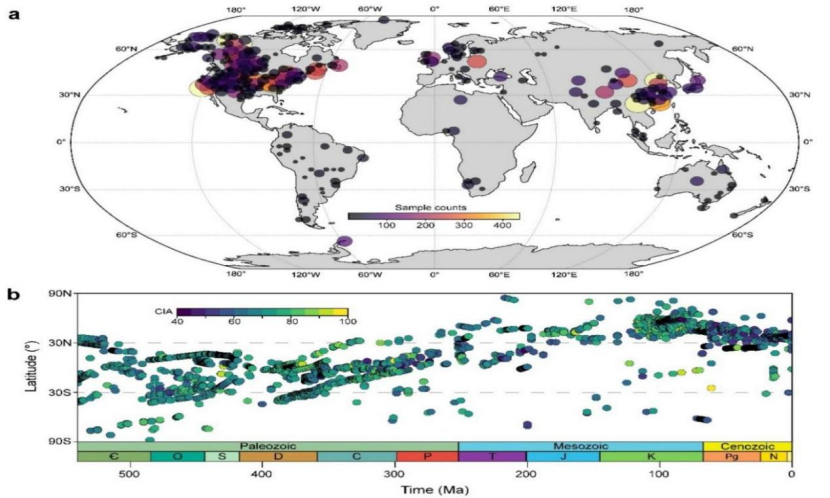
Overcoming the limitations of traditional paleotemperature reconstruction methods, the research team integrated extensive global sedimentary geochemical datasets and established a quantitative relationship between continental weathering intensity and temperature using the Chemical Index of Alteration (CIA). Combined with paleoclimate numerical simulations and data assimilation techniques, the approach enabled the reconstruction of a continuous global temperature record on a planetary scale, establishing a new paradigm for paleoclimate research.
The findings indicate that Earth’s global temperature has remained largely within a habitable range of 10–30°C over the past 540 million years, without prolonged periods of extreme heat. This pattern closely aligns with the fossil and evolutionary records of life on Earth.
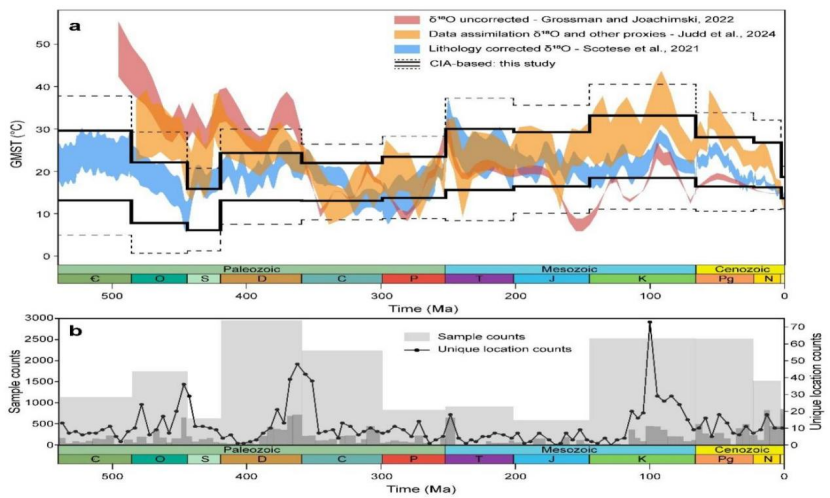
Mechanistic analyses further confirmed that the negative feedback associated with silicate weathering functions as a planetary “thermostat,” effectively stabilizing Earth’s climate over geological timescales. The study quantitatively validates this self-regulating mechanism and helps explain one of the fundamental reasons why Earth has remained habitable for hundreds of millions of years.
The research demonstrates that Earth’s climate has been consistently regulated by internal planetary processes over vast timescales and that the long-term flourishing of life has depended on the planet’s remarkable capacity for self-regulation.
Paper Link: https://doi.org/10.1038/s41467-026-72672-6