In a recent scholarly triumph, Professor Zou Hao, a distinguished member of both the College of Earth and Planetary Sciences and the State Key Laboratory of Oil and Gas Reservoir Geology and Exploitation at CDUT, as the first author and corresponding author, published an academic paper titled An oxygen isotope perspective on the break-up of the Rodinia supercontinent in the top international journal of Earth sciences, Earth-Science Reviews (with an impact factor of 12.1). Co-authors include Li Xianhua, a member of the Institute of Geology and Geophysics at the Chinese Academy of Sciences, Professor Pirajno Franco from the University of Western Australia, Associate Researcher Cao Huawen, and Ph.D. student Huang Changcheng, both from CDUT.
The coalescence and subsequent fragmentation of the Rodinia supercontinent in the Neoproterozoic era stand as pivotal episodes in our planet's history, critically influencing the oxygenation of the Neoproterozoic seas and atmosphere, the rapid evolution of multicellular organisms, and triggering a cascade of Earth system transformations. The quest to map the Rodinia supercontinent's reconstruction models and breakup dynamics, however, is marked by ongoing debate. Earth's magmatic rocks, characterized by notably lower δ18O values than those typically found in mantle magmas (δ18O<5.3 ± 0.6‰), are a geological rarity, with rift zones being the prime settings conducive to the genesis of low-δ18O magmas. Consequently, delving into the mid-Neoproterozoic era's low-δ18O magmatic rocks holds crucial insights for elucidating Rodinia's reconstruction models and breakup dynamics.
In this paper, we've amassed oxygen isotope data from 13,500 zircons across the globe (depicted in Figure 1), shedding light on the isotopic composition of zircons to advance our understanding of the Rodinia supercontinent's reconstruction models and breakup dynamics. Through a detailed analysis of the elemental and isotopic compositions of mid-Neoproterozoic low-δ18O magmas, particularly those from South China, the study has led to groundbreaking insights:
The pervasive presence of mid-Neoproterozoic low-δ18O magmatic rocks is deeply associated with numerous episodes of extensive remelting of upper crust materials.
The low-δ18O magmas, indicative of the Rodinia supercontinent's breakup era, predominantly emerged in continental rift extension zones, forming through oxygen isotope exchange between near-surface rocks at high temperatures and surface water.
The distinct paths of low-δ18O magmatic rocks stand as vital markers for piecing together supercontinent reconstruction models. The ongoing identification of such magmatic rocks on Earth is poised to provide more accurate constraints for delineating the Rodinia supercontinent's reconstruction model.
This study was graciously supported by the National Natural Science Foundation of China (42272129), the Science Fund for Distinguished Young Scholars of Sichuan (23NSFJQ0162), and the Everest Scientific Research Project at CDUT.
Article Link: https://doi.org/10.1016/j.earscirev.2024.104736
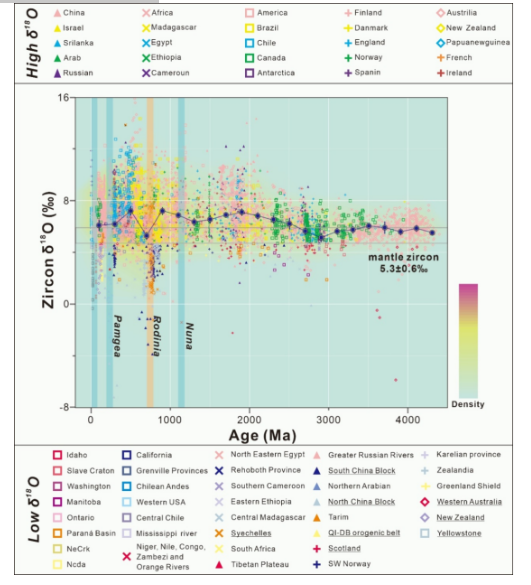
Figure 1: Compilation of Global Zircon U-Pb Ages and δ18O Values
Earth-Science Reviews stands as the pinnacle of scholarly journals in the Earth sciences realm, esteemed for its publication of groundbreaking foundational theoretical research and comprehensive reviews that embody a global perspective. The latest Impact Factor for Earth-Science Reviews is 12.1, with a CiteScore of 20.