Recently, Associate Researcher Han Zhong from the Institute of Sedimentary Geology of CDUT published a paper titled Spatially Heterogenous Seawater δ34S and Global Cessation of Ca-sulfate Burial During the Toarcian Oceanic Anoxic Event in the internationally renowned Earth and Planetary Science Letters of Nature Index (NI). This research offers a new perspective on marine sulfur cycling during the Toarcian oceanic anoxic event. Associate Researcher Han Zhong from our Institute of Sedimentary Geology is the first author of the paper, with Professor Hu Xiumian from Nanjing University as the corresponding author. Other co-authors include Associate Professor Robert Newton, Professor Benjamin J. W. Mills, Dr. Robert Jamieson from the University of Leeds in the UK, Professor He Tianchen from Hohai University, Professor Hugh Jenkyns from the University of Oxford, and Assistant Professor Micha Ruhl from the University of Dublin. This research was jointly funded by the National Natural Science Foundation of China (Grant No. 41888101), the Excellent Youth Foundation (Grant No. 42002121), the General Program (Grant No. 42272116), the Disciplinary Leading Innovation Team of CDUT, and the Everest Scientific Research Project.
The Early Jurassic Toarcian Oceanic Anoxic Event (T-OAE) is a typical global rapid warming event in the Mesozoic era. It is characterized by a significant release of CO2 into the atmosphere-ocean system, leading to a rapid and substantial global warming. This event is commonly associated with volcanic eruptions from the Karoo-Ferrar large igneous province. Global climatic and environmental changes related to the T-OAE include ocean acidification, rapid sea-level rise, intensified continental weathering, increased nutrient input, biotic turnovers, extinctions, arid conditions on land, plant migration to higher latitudes, enhanced hydrological cycles in lakes, and increased oxygen depletion. As one of the most typical extreme warming events in the Mesozoic era, the T-OAE provides a valuable case study for understanding global changes and ecological impacts under conditions of rapid warming. It holds important implications for the climate and environmental changes that may occur on Earth in the current context of global warming. However, during the T-OAE, there were significant spatial variations in the redox conditions of the water bodies. The characteristic sediments of oxygen deficiency (organic-rich deposits) have mainly been reported in northern Europe and specific deep-sea sediments. This has led to discrepancies, conflicts, and contradictions in the overall assessment, deoxygenation processes, and sedimentary evidence of oceanic anoxia during this period. This study employs high-precision carbonate lattice sulfur isotope (δ34SCAS) tracing to investigate the variations in global redox conditions during the Toarcian period and attempts to address the aforementioned scientific issues.
The δ34S results reveal a significant positive shift from the Pliensbachian-Toarcian boundary (δ34SCAS: ~20‰) to the end of the negative carbon isotope excursion (nCIE) associated with the T-OAE (δ34SCAS: ~40‰). Subsequently, sulfur isotopes remain at high values of approximately ~40‰ until the end of the Toarcian period (Fig. 1). Notably, there are marked differences in the magnitude of the positive shift (Xizang, formerly known as Tibet: ~20‰ vs. Europe: ~5%) and the sustained high values (Xizang: ~40‰ vs. Europe: ~25%) of sulfur isotopes during the T-OAE in the eastern Tethys Xizang region compared to Europe. These observations indicate substantial spatial heterogeneity in the δ34S composition of Toarcian seawater sulfate. Based on the fundamental principles of sulfur cycling and the chronostratigraphic work on the T-OAE nCIE, the process leading to the positive shift in δ34S isotopes persisted for approximately 1.4-1.5 million years (Fig. 2E). This suggests that the early Toarcian experienced a prolonged period of seawater deoxygenation. Furthermore, the high-precision δ34S data indicate two distinct phases of deoxygenation, with the second phase terminating at the end of the T-OAE nCIE. The current δ34S data and sedimentary evidence imply that the high δ34S values in Xizang may be a consequence of upwelling of sulfur-rich material from nearby low-latitude regions, which are the primary burial sites for organic matter and pyrite. In contrast, the European region may have experienced reduced burial of regional pyrite.
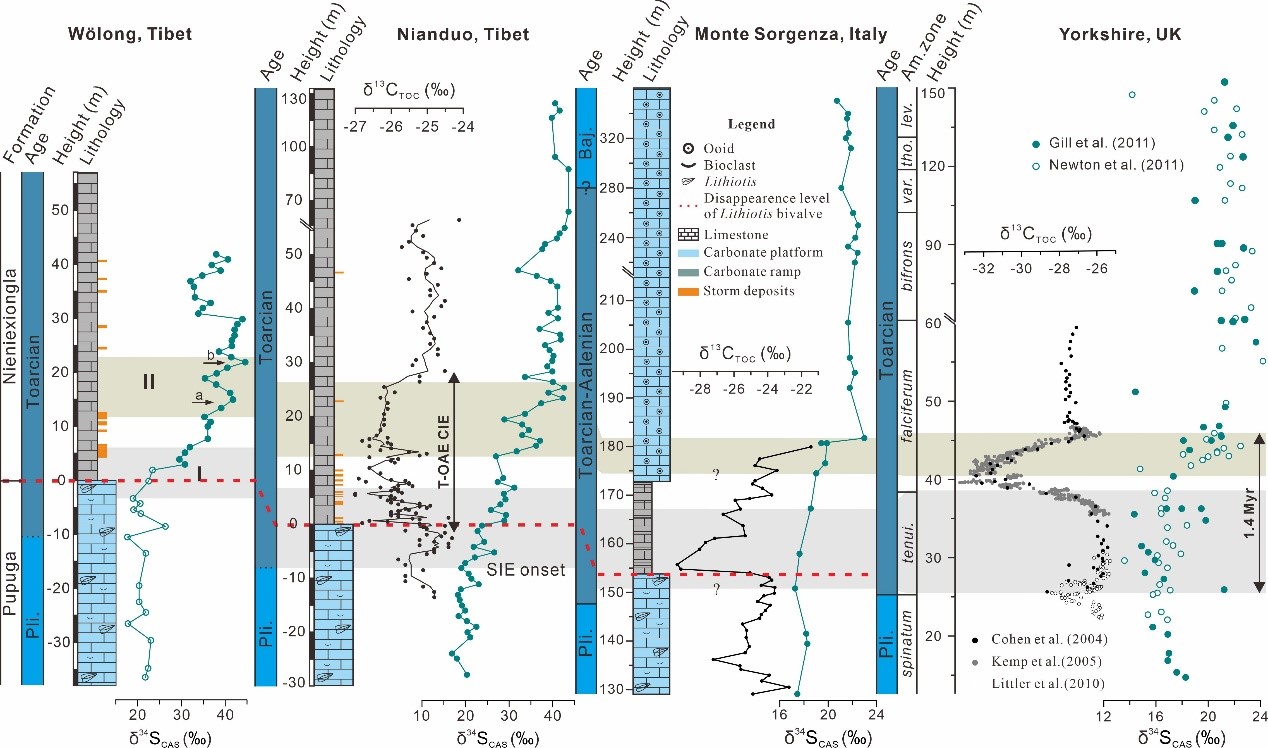
Comparison of δ34SCAS in the Tethys Himalayas (Wölong and Nianduo sections) with global data.
The sulfur isotope model suggests that gypsum deposition near the global oceanic stagnation is significantly increased in the burial proportion of pyrite (reduced state) only under the condition of very low sulfate concentration (~1 mM, far lower than the present-day ocean's 29 mM), but at the same time, it significantly reduces the total burial amount, thus maintaining high δ34S values for about 8 million years (Fig. 2). This study establishes the connection between low sulfate concentration, gypsum burial, and high δ34S values in seawater sulfate, which may be applicable to other periods with similar sulfur isotope records. It also poses a challenge for the quantitative assessment of the global pyrite burial flux and marine anoxia during periods of spatially heterogeneous seawater sulfate δ34S values.
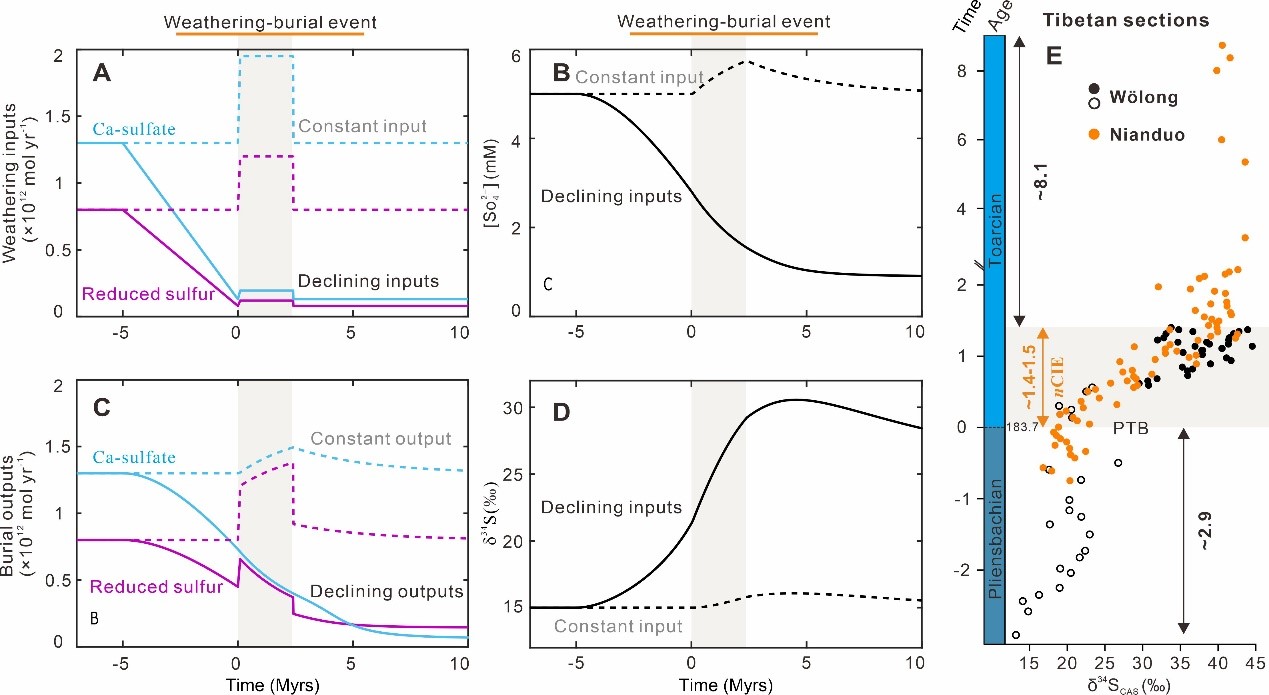
Long-term Sulfur Cycle Model for the Early Jurassic Pliensbachian-Toarcian Period
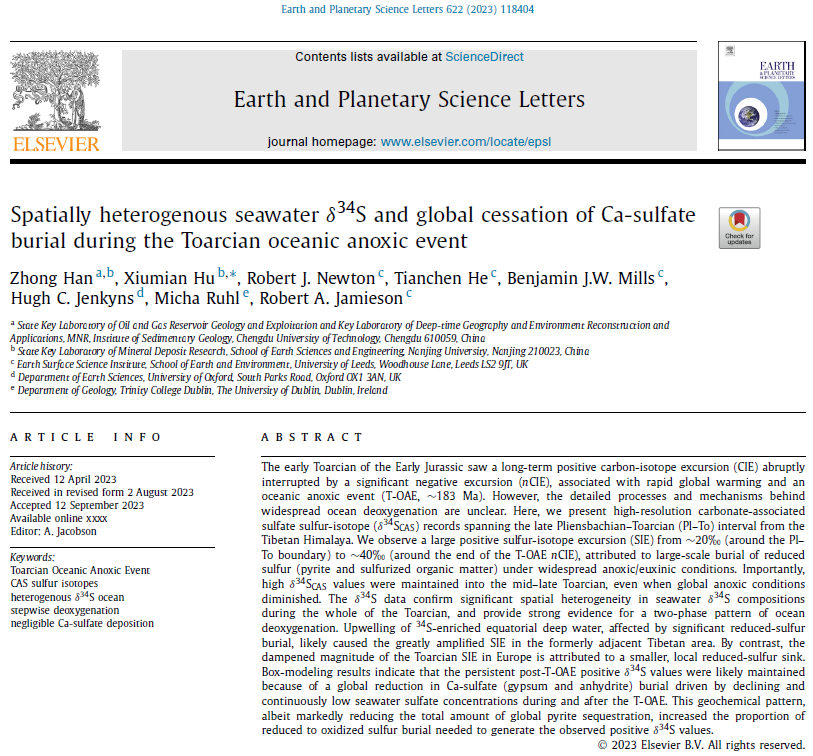
Han, Z., Hu, X., Newton, R.J., He, T., Mills, B.J.W., Jenkyns, H.C., Ruhl, M., Jamieson, R.A., 2023. Spatially heterogenous seawater δ34S and global cessation of Ca-sulfate burial during the Toarcian oceanic anoxic event. Earth Planet. Sci. Lett. 622, 118404.
Han, Z., Hu, X., Newton, R.J., He, T., Mills, B.J.W., Jenkyns, H.C., Ruhl, M., Jamieson, R.A., 2023. Spatially heterogenous seawater δ34S and global cessation of Ca-sulfate burial during the Toarcian oceanic anoxic event. Earth Planet. Sci. Lett. 622, 118404.
Link to the Paper: https://www.sciencedirect.com/science/article/pii/S0012821X2300417X?dgcid=author