Recently, Researcher Tan Yu, a young teacher from the Department of Engineering Mechanics, College of Environment and Civil Engineering, Chengdu University of Technology (CDUT), published a research paper titled "Phase field model for brittle fracture in multiferroic materials" in Computer Methods in Applied Mechanics and Engineering (CMAME), a top journal in computational mechanics (Chinese Academy of Sciences Ranking Q1, TOP journal, IF: 7.2). The paper reported new progress in the research on fracture behavior of multiferroic materials under coupled physical field conditions, with CDUT as the first completion unit, Professor Li Xiangyu from Southwest Jiaotong University as the corresponding author, and co-authors including Assistant Professor Liu Chang and doctoral student He Yuxiang from Southwest Jiaotong University, Dr. Zhao Jinsheng from The Chinese University of Hong Kong, and Associate Professor Li Peidong from Sichuan University.
Figure 1: First Page of the Paper
Multiferroic materials are a new type of smart material composed of piezomagnetic and piezoelectric materials. They exhibit excellent piezomagnetic, piezoelectric and electric and magnetic coupling effects, can rapidly realize conversion between magnetic, electrical and mechanical signals and thus have broad application prospects in fields such as biomedicine, energy, electric power and aerospace. However, multiferroic materials are generally brittle and have poor fracture toughness, therefore, they are susceptible to fracture under magnetic, electric and mechanical loads, which can affect the normal operation of related equipment or even lead to complete equipment failure. As a result, accurately predicting the fracture behavior and quantifying the crack propagation process of multiferroic materials has become a key scientific problem that urgently needs solving.
In response to the brittle fracture in multiferroic materials, the paper combined the virtual displacement principle with the second law of thermodynamics, introduced two phase field models, AT1 and AT2, considered the coupling relationships among magnetic, electric and elastic fields and established a fracture phase field model that could predict the entire process of crack initiation, propagation and failure in multiferroic materials. In particular, the paper constructed a new expression for energy density and introduced, for the first time, four ideal electric and magnetic boundary conditions within the phase field framework: electrically and magnetically impermeable, electrically permeable but magnetically impermeable, electrically impermeable but magnetically permeable, and electrically and magnetically permeable, and the paper derived corresponding constitutive equations for multiferroic materials. In the meantime, the paper developed a numerical algorithm for crack propagation within a magneto-electro-elastic mechanics framework, established a simulation platform based on the finite element method and significantly enhanced computational efficiency and accuracy compared to the "single-pass" staggered algorithm.
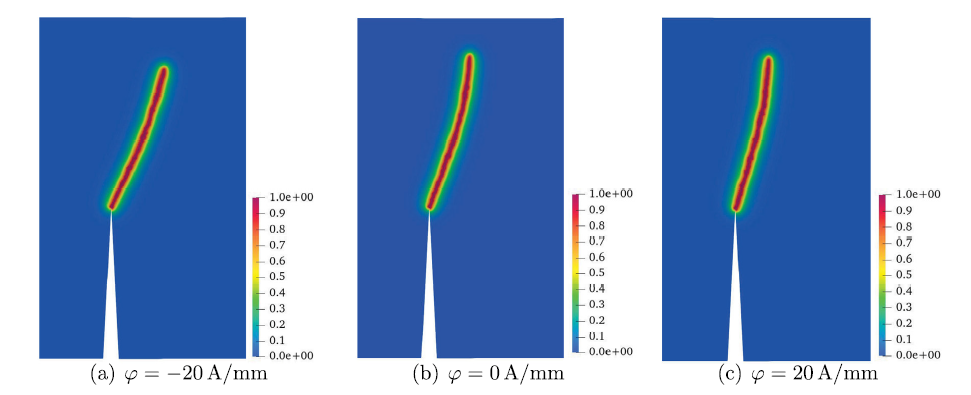
Figure 2: Crack Propagation Paths of Multiferroic Materials under the Influence of Different External Magnetic Fields
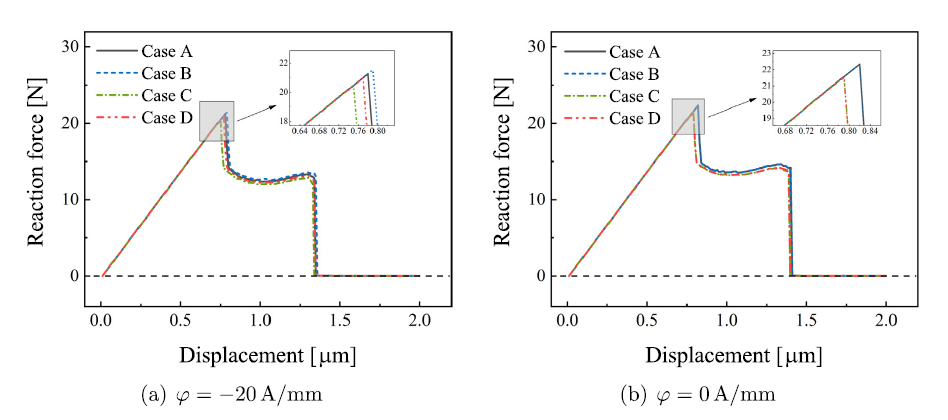
Figure 3: Load-Displacement Response of Multiferroic Materials under Different Electric and Magnetic Boundary Conditions
The paper systematically studied the fracture behavior of multiferroic materials under coupled physical field conditions through numerical simulations, revealed the laws of the influence of external magnetic and electric fields and crack surface electric and magnetic boundary conditions on crack propagation and clarified the evolution mechanism of crack initiation and propagation in multiferroic materials. Further, the study discovered that key fracture characteristics of multiferroic materials, such as load-displacement response and crack propagation path, are regulated by electric and magnetic boundary conditions and external electric and magnetic fields. The fracture phase field model developed in the paper can address crack propagation problems in multiferroic materials under different dimensions and loading conditions. The research achievement will provide strong support for the safe service of multiferroic materials and components in complex environments.
Paper link: https://doi.org/10.1016/j.cma.2023.116193