Professor Xia Guoqing and Researcher Wu Chihua from Institute of Sedimentary Geology Publish a Research Result Titled "Eocene-Oligocene Glaciation on a High Central Tibetan Plateau" in the Journal Geology
Professor Yi Haisheng's team from the Institute of Sedimentary Geology at Chengdu University of Technology (CDUT) has recently published a research result titled "Eocene-Oligocene glaciation on a high Central Tibetan Plateau" in Geology, an international authoritative journal in earth sciences. This is the first time that the research team has discovered Eocene-Oligocene glacial relics on the Central Tibetan Plateau. CDUT is the first completion unit of the paper, Professor Xia Guoqing is the first author, Researcher Wu Chihua as well as Researcher Pei Junling from the Institute of Geomechanics, Chinese Academy of Geological Sciences are co-corresponding authors, and Professor Yi Haisheng, Professor Juan Pedro Rodríguez-López, Professor Shi Zhiqiang, Associate Professor Jin Xin, and Master's student Fan Qiushuang participated in the research. Further, other participants included Professor Julian B. Murton from the Permafrost Laboratory, University of Sussex in the UK, Dr. Ahmed Mansour from Minia University in Egypt and Dr. Li Gaojie from Mianyang Teachers' College.
The research team conducted basic sedimentology research on four typical frozen sediments, separately, ice crystal imprints, ice-rafted debris, hexahydrate calcite (pseudocrystal) (Figure 1) and periglacial mélange and explored their backgrounds and paleotopographic conditions. The research pointed out that the formation period of these glacial relics in the Lunpola Basin was 36.2-31.8 Ma, consistent with the evolution process of the Arctic's cryosphere in the same period. The research provides important reference data for studying the formation process of the continental cryosphere in the early Cenozoic era in the mid-latitude regions of the Northern Hemisphere. The research also pointed out that the presence of ice crystal imprints suggests that a typical frost climate appeared in the Central Tibetan Plateau, while the presence of ice-rafted debris and periglacial mélange suggests that the region was in a periglacial environment, implying the existence of mountain glacial records on the central plateau. The paper, in conjunction with the ultralong duration of these glacial relics (4.4 Ma) and paleolatitude data from previous studies (northern latitude 25°, subtropical region), pointed out that the formation of these glacial sediments cannot be simply attributed to the single-factor EOT cold event (because it lasted only 790 kyr) but was highly likely caused by the reaching of the cryosphere critical height in the central plateau (3-4 km asl). Therefore, the Eocene-Oligocene glacial relics in the Lunpola Basin provide an important time node for studying the Central Tibetan Plateau's formal transition into the plateau geomorphology.
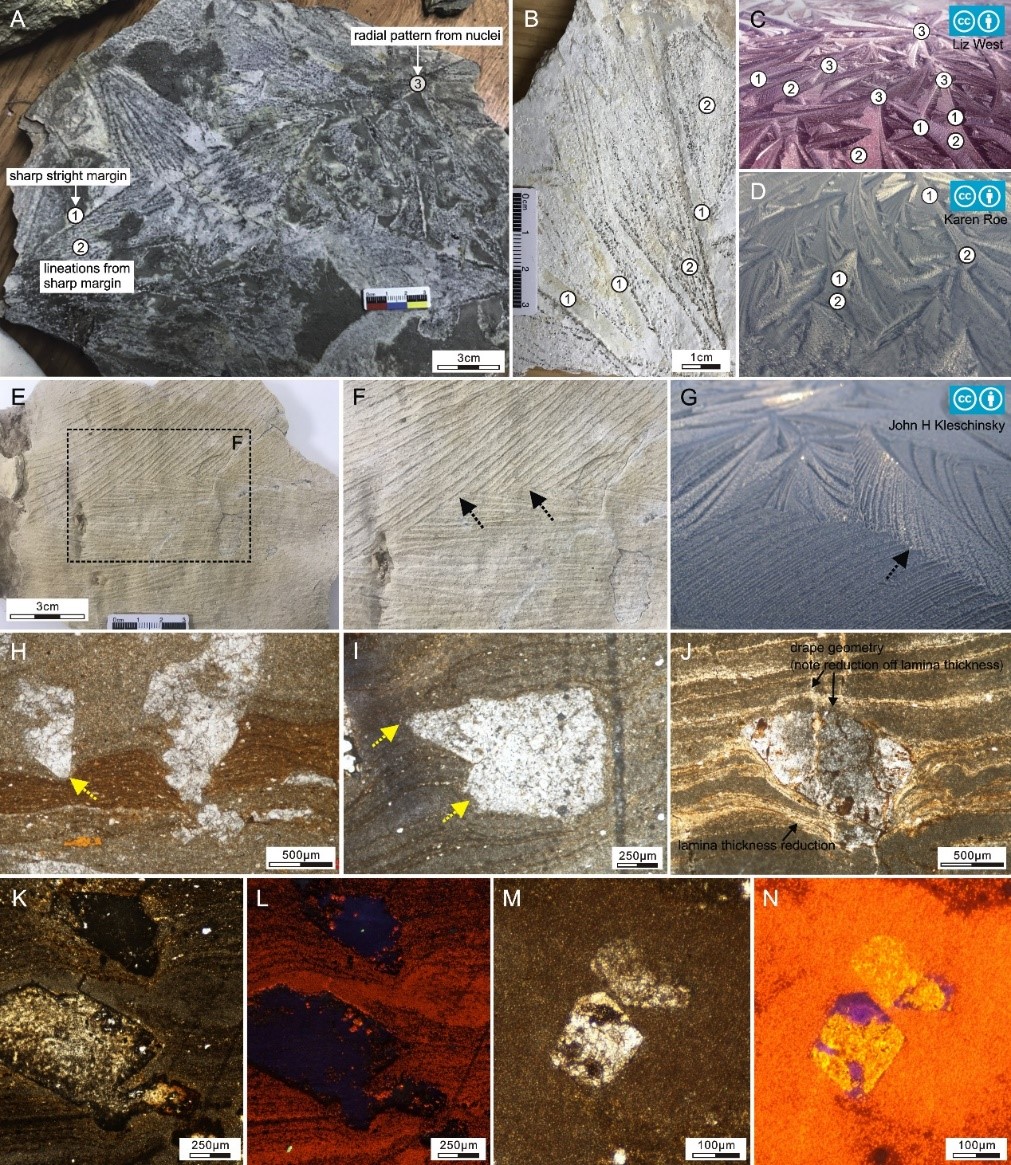
Figure 1 Typical Ice Crystal Fossil Imprints and Hexahydrate Calcite (Pseudocrystal) in Second Member of Niubao Formation in Lunpola Basin
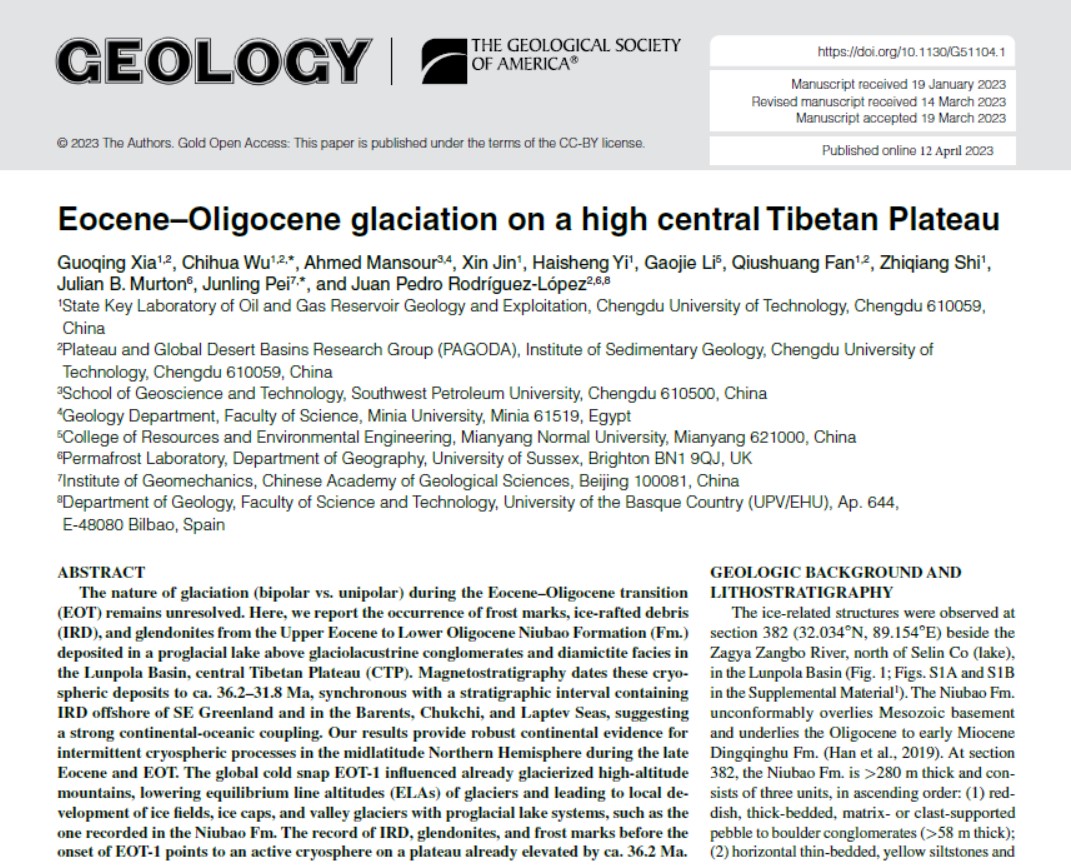
First Page of the Paper in Geology
Original article link and DOI: https://doi.org/10.1130/G51104.1
Citation: Xia, G.Q., Wu, C*., Mansour, A., Jin, X., Yi, H.S., Li, G.J., Fan, Q.S., Shi, Z.Q., Murton, J. B., Pei, J.L*., and Rodríguez-López, J. P. (2023). Eocene–Oligocene glaciation on a high central Tibetan Plateau: Geology,https://doi.org/10.1130/G51104.1.
Sponsored by the Geological Society of America, Geology is a Nature Index journal that has been ranked as the top academic journal in earth science impact by the Web of Science for 12 consecutive years.