Plateau Uplift Team of Everest Scientific Research Project Publishes a Research Result Related to "Thermal Structure and Differential Exhumation of the Eastern Tibetan Plateau Margin" in Earth-Science Reviews, an International Top Earth Science Journal
The Plateau Uplift Team of the Everest Scientific Research Project of Chengdu University of Technology (CDUT) has recently published an important research result titled “Late Cretaceous – Cenozoic thermal structure and exhumation of the Eastern Tibetan Plateau margin: A doubly-vergent orogenic wedge” in Earth-Science Reviews, an international top earth science journal. The result established for the first time Late Cretaceous - Cenozoic thermal structure sections of the eastern Tibetan Plateau margin, determined the timing, magnitude and spatial extent of two episodes of exhumation, one during the Late Cretaceous and the other during the Late Cenozoic and discovered a Late Cenozoic rapid exhumation belt up to about 150 km wide on the eastern plateau margin. The State Key Laboratory of Oil and Gas Reservoir Geology and Exploitation, CDUT (Laboratory) is the first completion unit for the result, Prof. Li Zhiwu and Prof. Liu Shugen from the Laboratory are the first author and only corresponding author of the paper, respectively, and Prof. Peter J.J. Kamp and Researcher Ganqing Xu from the University of Waikato, New Zealand and Associate Professor Martin Danišík from Curtin University, Australia are the co-authors of the paper.
The Longmen Mountain on the eastern Tibetan Plateau margin has one of the largest topographic gradients in the world and is thus considered to be an ideal zone for deciphering the eastward growth process of the Tibetan Plateau. It has become a hotspot in the global earth science community since the 2008 Wenchuan earthquake. Numerous scholars at home and abroad have conducted a tremendous amount of research work to demonstrate two popular endmember models: the lower crustal flow model and the thrust model. However, a mass of low-temperature thermochronological data is mainly limited to fault zones, deeply incised valleys or the vicinity of individual rock masses, which seriously limits the overall identification of the spatial and temporal distribution of uplift-exfoliation on the eastern Tibetan Plateau margin.
In response to the above issue, in reliance on a Major Program of the National Natural Science Foundation of China and the Everest Scientific Research Project, Prof. Liu Shugen, Prof. Li Zhiwu, etc. from the Laboratory worked together with domestic and foreign scholars to gain important insights based on low-temperature thermochronological studies of three deep drill-holes (about 7 km) on the eastern Tibetan Plateau margin: HC-1 on the Zoige Plateau, LS-1 on the front margin of the Longmen Mountain thrust belt and CK-1 in the Western Sichuan foreland basin as well as the sections of a 400-km-long surface belt that connects the three deep drill-holes.
The research result provides considerable inspiration for the uplift history and eastward growth process of the Tibetan Plateau. Further, the research has for the first time applied the low-temperature thermochronology mapping method that combines the surface belt section with drill-hole depth or surface elevation section, to successfully establish thermal structure sections of the eastern Tibetan Plateau margin and set up a typical case studying the uplift-exfoliation and growth process of the Tibetan Plateau and the dynamic mechanism thereof, which can provide new ideas for subsequent studies.
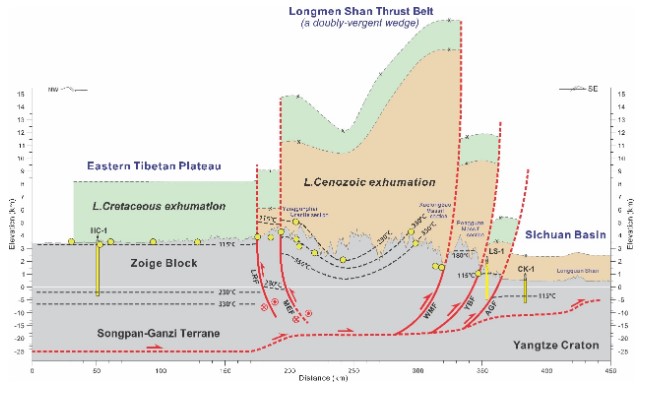
Late Cretaceous – Cenozoic Thermal Structure of the Eastern Tibetan Plateau Margin
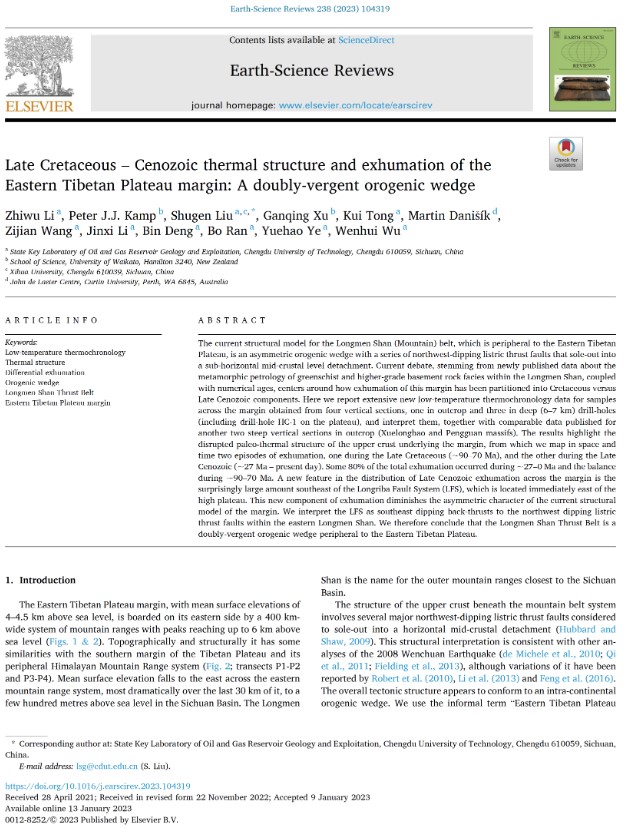
First Page of the Article in Earth-Science Reviews
Original article link and DOI:
https://www.sciencedirect.com/science/article/abs/pii/S0012825223000089