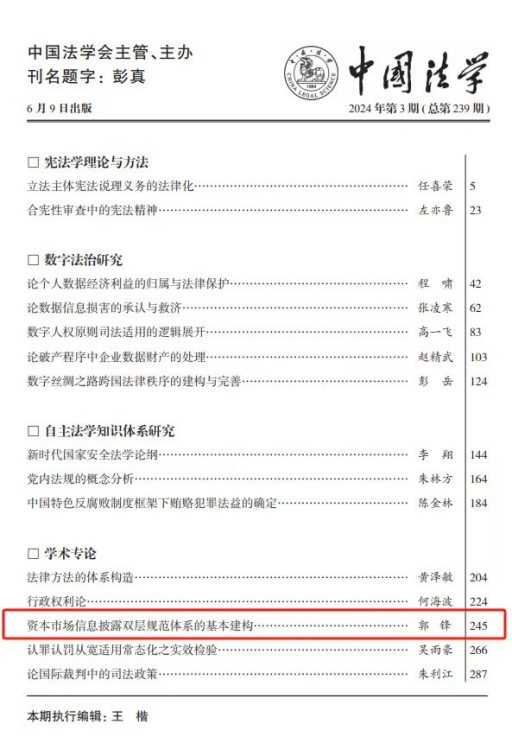
Recently, Professor Guo Feng, Distinguished Dean of Humanities and Law at CDUT, published a research paper titled The Basic Construction of a Two-Tier Norm System for Information Disclosure in the Capital Market in the prestigious legal journal China Legal Science (2024, Issue 3). The paper was first released on CNKI and simultaneously featured on the WeChat Official Account China Legal Science.
The paper addresses the norms governing information disclosure in China's capital market, focusing on public issuance while noting the lack of systematic regulations for private placements. It advocates for the establishment of a two-tier norm system for information disclosure, covering both public and private issuances. By leveraging theoretical tools from contract economics—namely, incentive mechanisms and risk mitigation mechanisms—to tackle information asymmetry, the paper proposes a comprehensive two-tier information disclosure system. Introducing the concept of a "two-tier norm system for information disclosure," the paper explores its formation mechanisms and theoretical underpinnings. It then conducts a comparative analysis and research from the three interconnected and interrelated dimensions of legislation, regulation, and judiciary.
Information disclosure is the bedrock of securities law and the cornerstone of securities regulation. A well-structured and effectively enforced information disclosure system is vital for capital market development and investor protection. In the course of developing China's capital market, the information disclosure system has gradually improved, particularly for public issuances, which have achieved a high level of maturity. On the other hand, private placements have traditionally been regulated by multiple agencies across the securities, banking, insurance, and trust sectors. It was only with the 2005 PRC Securities Law that a legal framework for private placement information disclosure began to take shape. Unlike the systematic arrangement seen for public issuances, private placements have not yet received the same level of comprehensive institutional structure. For a robust capital market, an effective information disclosure system for private placements is equally essential.
This paper delves into the formation mechanism of the two-tier norm system for information disclosure by examining its origins, marginal expansion, and interrelationship. It employs the theory of asymmetric information from contract economics as the theoretical foundation for this study. Through the lens of law and economics, the paper categorizes the two-tier norm system for information disclosure into incentive norms and risk mitigation norms. Incentive norms are designed to align the interests of companies, shareholders, and issuers through targeted incentives, prompting issuers to voluntarily disclose accurate information and act in the best interests of investors. Risk mitigation norms, on the other hand, view securities law as a tool for addressing investment risks by establishing a "shared risk contract between principals and agents," simplifying regulatory processes, reducing capital formation costs, and more effectively protecting investors. The author then examines how to construct the two-tier norm system for information disclosure from three dimensions: legislative logic, regulatory mechanisms, and judicial application. By extensively citing and analyzing domestic and international judicial cases and legal provisions, the paper offers theoretical support and practical guidance for the further development of the capital market and investor protection. On the legislative front, incentive norms should aid issuers in selecting suitable fundraising methods based on cost-benefit analysis, while risk mitigation norms should focus on the circulation of shares and investor qualification. In terms of regulation, public issuances should implement a registration-based regulatory system centered on information disclosure, whereas private placements should adopt an exemption-based regulatory system prioritizing efficiency. For risk mitigation norms, public issuance regulation should clarify the responsibilities of relevant parties, while private placement regulation should define the scope of private placements and limit the use of public solicitation rules. In the judicial realm, since false statements in public issuances typically involve tort liability and those in private placements often involve breach of contract liability, there should be a clear distinction in the civil liability claims basis for false statements under the two-tier norms.