Our University Successfully Held the First China-Belgium Humanities and Academic Exchange International Conference
On October 20, 2022, our university successfully held the "China-Belgium Humanities Exchange and Interdisciplinary Research Seminar" online. This is the first seminar of Chengdu University of Technology's autumn series of Sino-foreign humanities and academic exchange, which is of great significance to promote exchanges between
China
and
Belgium
in the fields of humanities and interdisciplinary fields, and to facilitate international academic dialogues and interdisciplinary talent cultivation. Li Shan, deputy director of the Department of International Exchanges & Cooperation, presided over the opening ceremony of the conference. President Liu Qingyou of Chengdu University of Technology and President Rik Van de Walle of Ghent University delivered speeches respectively through videos, expressing their greetings to the participating scholars and young students. More than 200 key faculties from the College of Foreign Languages & Cultures of our university, Mt. Everest Talents, all master's students and some undergraduates, as well as scholars and young students from domestic and foreign cooperative universities and academies in multiple time zones around the world participated in the conference online.
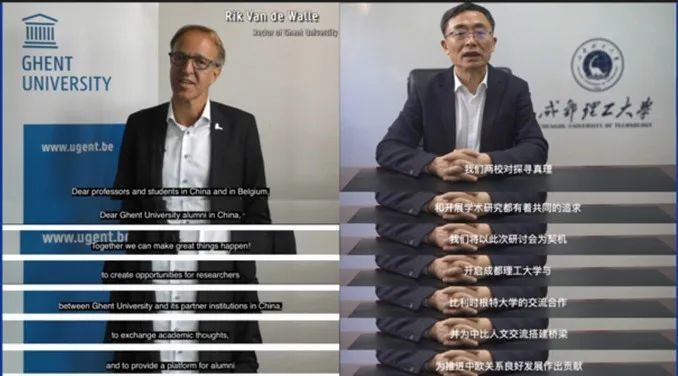
▲Rik Van de Walle of
Ghent
University
(left) and President Liu Qingyou of Chengdu University of Technology (right) deliver their speeches
President Liu Qingyou said in his speech that he would like to take this seminar as an opportunity to start the exchange and cooperation between Chengdu University of Technology and Ghent University in Belgium, promote the humanities and academic exchanges and interdisciplinary talent cultivation cooperation between the two universities as well as the exchange of visiting faculties and students, share academic resources, and continue to deepen their friendship. He hoped that the seminar can help participants broaden their horizons, receive inspiration, and gain new knowledge, build a bridge for China-Belgium humanity and cultural exchanges, and contribute to the sound development of China-EU relations.
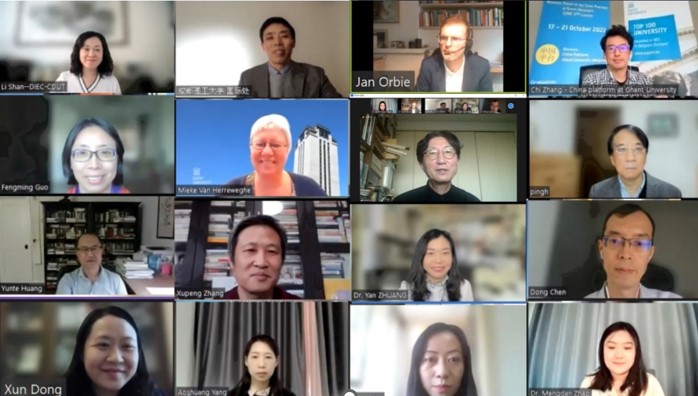
▲ Group photo
The seminar is themed "Conceptual/Theoretical Mobility Across Time and Space". Professor Mieke Van Herreweghe, vice president of
Ghent
University
and a well-known linguist, analyzed the research tradition, significance and methods, as well as the latest results in this field on the topic of "Sign Language Linguistics and General Linguistic Theory". Professor Jan Orbie, director of the Center for European Union Studies at Ghent University, gave a speech titled "European Union Trade Discourse Towards China: What Does 'Open Strategic Autonomy' Mean?" and in combination with one of his latest research results, he proposed an analytical conclusion of three indicators of "Openness", “Sustainability” and “Confidence” in EU policy discourse. Professor Amamura Yuiji, an expert in oriental culture research at
Fukuoka
International
University
in
Japan
, delivered a wonderful speech on "The Analects of Confucius in
Japan
" with reference to the historical facts of Prince Shotoku's writing of legal provisions in Japanese history books. Professor He Ping from the School of History & Culture,
Sichuan
University
, delivered a speech on "The Idea of the Enlightenment across the National Boundary", presented a philosophical explanation on how to combine enlightenment with the needs of the post-epidemic era, and guided students to take an in-depth insight on the significance of cultural exchanges between
China
and foreign countries. Professor Huang Yunte from the English Department of the
University of
California
, Santa Barbara, gave a speech titled "Chinese Whispers: toward a Transpacific Poetics". He pointed out that by conceptualizing text as a carrier of technology, it can reshape the world through artistic aesthetics. Research Fellow Zhang Xupeng from the Institute of Historical Theory of the Chinese Academy of Social Sciences gave a speech on "Ideas and Space: The Flow and Changes of Ideas from a Transnational Perspective", where he pointed out that the connotation of concepts will undergo various changes after entering a new space, and further analyzed the complications that may arise after "misappropriation" of the concept. In his speech titled "Semantic Changes in the Translation of Confucian Concepts into English", Professor Liu Yongzhi, dean of the College of Foreign Languages & Cultures, Chengdu University of Technology, advocated the use of "pinyin transliteration" and "Chinese + annotation" for translation, so that Western readers can have a direct understanding of the theoretical system of Confucianism and its unique humanistic value.
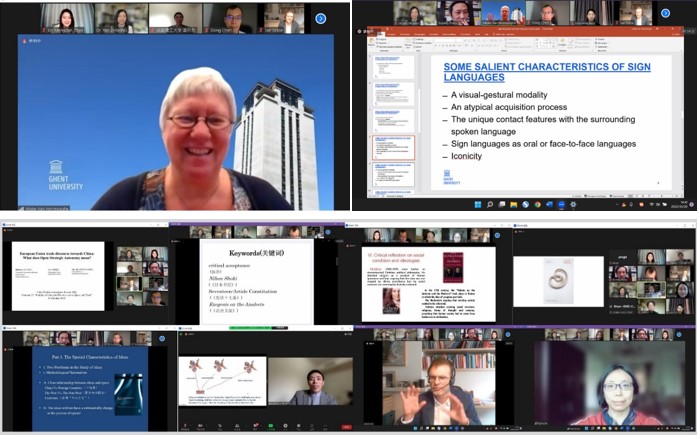
▲Wonderful speeches by experts and scholars
At the meeting, experts, scholars and young students from different countries made wonderful speeches and carried out heated discussions on the evolution of important concepts and theories in humanities and social sciences in the context of globalization, as well as new challenges in research, with a goal to jointly promote the construction of an inclusive interdisciplinary communication, cooperation and research platform.