To foster advancements in lunar science research and cultivate the next generation of planetary science experts, the International Center for Planetary Science at CDUT's College of Earth and Planetary Sciences hosted the "2024 Lunar Science Summer Short Course" from June 25 to 30, 2024. The event took place in the Academic Lecture Hall of CDUT. The opening ceremony was presided over by Professor Liu Yun, Distinguished dean of the College of Earth and Planetary Sciences. Professor Hou Mingcai, Vice President of CDUT, and Professor Shi Zeming, Secretary of the Party Committee of the College, delivered keynote speeches. Professor Lang Xinghai, Deputy Dean of the College, along with the main lecturers and teachers from the International Center for Planetary Science, also attended the ceremony.
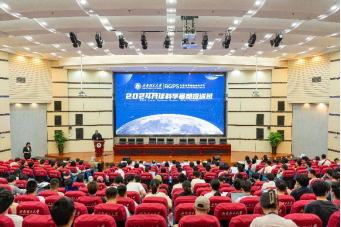
Professor Liu Yun presiding over the opening ceremony of the Lunar Science Short Course
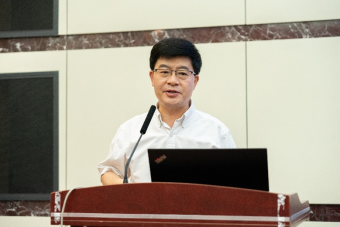
Professor Hou Mingcai delivering the welcome speech
The short course featured 14 thematic lectures delivered by a team of young experts at the forefront of lunar science research. The distinguished lecturers included Professor Sun Xinlei, Associate Professor Zhou You, and Associate Researcher Pang Runlian from CDUT, Dr. Zhang Yizhuo from Peking University, Professor Hui Hejiu from Nanjing University, Professor Xiao Zhiyong from Sun Yat-Sen University, Professors Wang Huapei and Huang Jun from China University of Geosciences (Wuhan), Researcher Yang Wei from the Institute of Geology and Geophysics of CAS, Researcher Liu Yang from the National Space Science Center of CAS, and Researchers Du Wei, Zhu Dan, Li Yang, and Associate Researcher Xu Yingkui from the Institute of Geochemistry of CAS.
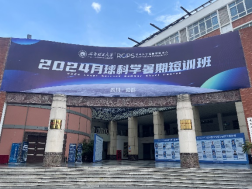
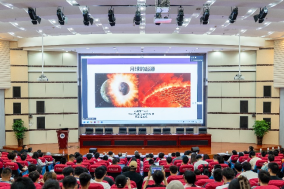
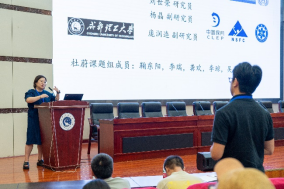
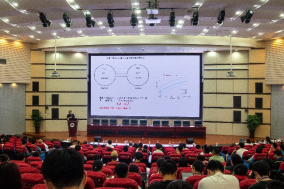
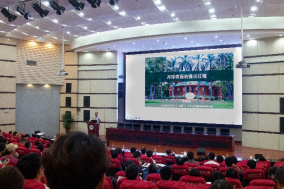
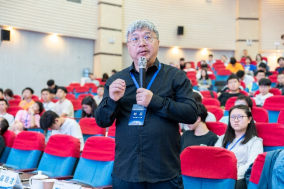
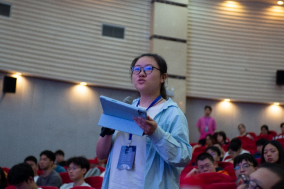
Venue and Scenes of the Short Course
The short course drew over 240 participants, predominantly undergraduates and graduates. They hailed from prestigious institutions worldwide including Harvard University in the US, RUDN University in Russia, University of Western Ontario in Canada, various institutes under the Chinese Academy of Sciences such as the Institute of Geochemistry, Institute of Geology and Geophysics, and Guangzhou Institute of Geochemistry, as well as the National Space Science Center, Institute of Modern Physics, Purple Mountain Observatory, and China Institute of Atomic Energy. Participants also represented prominent Chinese universities such as Peking University, University of Chinese Academy of Sciences, Nanjing University, University of Science and Technology of China, Wuhan University, Sun Yat-Sen University, Sichuan University, Northeastern University, China University of Geosciences (Beijing and Wuhan campuses), Northwest University, Shenzhen University, Macau University of Science and Technology, Capital Normal University, Sichuan Agricultural University, CDUT, Guangdong University of Technology, Guilin University of Technology, Shaoguan University, and Guizhou University of Engineering Science.
The short course created a vibrant academic atmosphere, focusing on "Lunar Science." Discussions revolved around the Moon's origins, differentiation of lunar magma oceans, formation of initial crustal layers, dynamic mechanisms behind solidification and crust formation, lunar oxygen escape and non-traditional isotope compositions, lunar magnetic fields, internal structure and evolution, impact processes, volcanic activity on the Moon, formation and evolution of lunar mare basalts, progress and prospects in remote sensing of lunar surface water, lunar volatile compounds, scientific insights from lunar meteorites, and new revelations from the Chang'e-5 lunar sample. Extensive exchanges and in-depth discussions took place among young scholars in these cutting-edge fields. This successful short course has expanded CDUT's influence in lunar science research, provided a platform for young scientific workers to exchange ideas, and further promoted technological innovation and talent development in China's lunar science sector, injecting new momentum into the ongoing lunar science research in China.