Recently, the research team led by Professor Li Chao from Chengdu University of Technology (CDUT), in collaboration with domestic and international scholars, published their latest research findings titled “Recurring marine phosphorus spikes during major Palaeozoic mass extinctions and climate change” in the top-tier international journal Nature Communications.
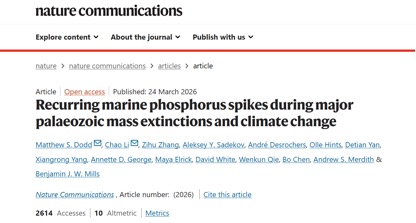
This study innovatively applies the “Carbonate-Associated Phosphate” (CAP) geochemical proxy, independently developed by Professor Li’s team, to systematically reconstruct—for the first time—the history of global marine phosphorus concentration changes during two major Phanerozoic mass extinction events: the Late Ordovician Mass Extinction (LOME, ~445 Ma) and the Late Devonian Mass Extinction (LDME, ~372 Ma).
The results show that during the critical intervals of both extinction events, CAP records from different ocean basins exhibit short-lived yet synchronous spikes, confirming that “phosphorus spikes” were a key driver of large-scale biotic crises and global cooling in the early Paleozoic. The study also provides the first detailed insights into the complex relationships between phosphorus—as the primary nutrient controlling marine productivity—and Earth’s early environmental and ecological systems.
This work not only deepens our understanding of the causes behind ancient biological crises, but also offers new perspectives on the intricate coupling mechanisms between global biogeochemical cycles and Earth’s environmental and life systems.
Publication details:
Dodd, M.S., Li, C., Zhang, Z., et al. Recurring marine phosphorus spikes during major palaeozoic mass extinctions and climate change. Nature Communications (2026). https://doi.org/10.1038/s41467-026-70701-y
The study was co-led by Professor Li Chao of CDUT and Dr. Matthew Dodd from the University of Western Australia, who served as co-first and corresponding authors. A total of 15 researchers from China, Australia, Canada, the United States, Estonia, and the United Kingdom contributed to the research.